Joshua Redman on tenor sax
Playing at the Newport Jazz Festival in 2000.
I last saw Joshua Redman playing with Brian Blade at the Monterey Jazz Festival.
Joshua Redman on tenor sax
Playing at the Newport Jazz Festival in 2000.
I last saw Joshua Redman playing with Brian Blade at the Monterey Jazz Festival.
Recently got this message from Tony, he plays guitar and sax. And had read my post about zen and saxophone- Beginner’s Mind Child’s Mind for Saxophone.
Hi Neal,
I play guitar and sax after a fashion, I’ve always been drawn to music, and learned sax for a while at school, absolutely loved it. Life got in the way for a long time and I finally picked up the sax again a year ago, started taking lessons about 6 months ago, so I’m very much a beginner. But something happened in between which was I became completely immersed in a world of blues. As a result my teacher says I have beautiful tone, and feeling to my licks, but can’t read music worth diddley 🙂
As for the guitar, I love my acoustic stuff, again I’m not great and play mostly for relaxation, but I can hold my own with some blues here and there, and a little bit of rock, spanish and a few other influences. The sad thing is, I have a beautiful acoustic that inspires me to play every time I look at it, but serving two masters, especially at my level of capability is tough, and even a week away from the sax sets me back significantly.
So to your original question, my main instrument is the sax now, but to be honest, from a musicians viewpoint, I play neither competently (although I’m much more competent in studio production and engineering), but have lofty goals to play sax in a Ska or Blues line up (both of which were missed from your poll incidentally!!) in the next 12 months.
Apols for the dissertation!! 🙂
Cheers
Tony.
Grover Washington Jr. playing some 70s style smooth jazz. He basically came up with the genre.
The CD ‘Winelight
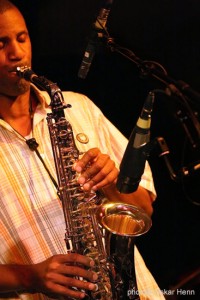
Saxophonist Evan Tate moved from the United States to Germany and has performed in many places around the world. He also teaches saxophone.
(Neal) Q:When and how did you start playing saxophone?
(Evan) A: My father was a musician (pianist, arranger) and was frequently on tour. He picked up jazz albums every once in a while travelling and brought them home. One day, when I was 11 years old, he brought Thelonius Monk’s Greatest Hits, a compilation album. I got turned on right away to the tune “Little Rootie Tootie” and loved Phil Woods’ solo on it. I started playing saxophone at the age of 12, when I entered into junior high school. My first choice was alto saxophone and my second choice was tenor.
Q: Which players have influenced you?
Aside from that solo from Phil Woods, Sonny Rollins, Charlie Parker, John Coltrane, Cannonball Adderley, then later Steve Grossman, Micheal Brecker, Dave Sanborn, Maceo Parker, Steve Coleman, and more.
Q: What kind of band are you playing with now?
A:I have now a “classic” jazz quartet. We play my compositions which range from through-composed experimental stuff, tunes based on standards, and re-arrangements of a couple of standards in odd meters.
In past years, I’ve had a trio with just drums and bass, and also type of fusion band with bass/e-bass, guitar and keyboards, along side the drums and myself.
Q: What have your favorite shows to play been?
A: I like playing in Austria and Switzerland along with performances in Germany. We may be performing in China in the future. Conditions and arrangements are still being discussed.
Q: What horn are you playing and what horns have you played before?
A: I’m playing Julius Keilwerth SX90R Black Nickel Alto sax. I’ve had black pads placed in my horn, not merely for cosmetic reasons, but the pads don’t stick as much as the normal brown pads. I formerly played a Selmer Mark VI (1957) alto. I still have it and it’s still a great horn. Sleek and elegant. It was my first real horn. I got that when I was 15.
I’m also playing a Keilwerth SX90 Soprano sax, nickel-plated, gold lacquer. Keilwerth doesn’t make this combination anymore (nickel-plated, gold lacquer) for their sopranos. I had it especially ordered because of the sound. I had also played a Selmer Mark VI soprano, but I unfortunately didn’t get a good one. I was in college then. I was buying the horn on lay-away from a dealer in Virginia at the time. By the time I had it paid off and had it in my hands, I really didn’t have much experience with buying a horn. I was never really satisfied with it. I tried many others, but I wasn’t really ready to switch though. After holding the Keilwerth in my hands, I knew right away that that was the horn I wanted to play.
Q: What’s the story of your first ebook on saxophone?
A: Well, the very first ebook was the “Way To Mastery Workout Book”. That was actually a product (as also my 2 CDROMs) of the Saxophone Workshops I’ve done in cooperation with Julius Keilwerth. I had always gotten good feedback from the workshops and handed out materials for free. Eventually people started emailing me with questions. So, I figured I would compile most of the exercises/techniques into a book and make it available for sale.
Q: What is the goal of the books on saxophone that you have written?
A: Well, on the side of jazz improvisation, I want to offer an alternative method to the “Chord/Scale Theory” of improvisation and spread the technique of “Jazz Etudes/ Improv Etudes” that I originally learned from Steve Grossman, as a more effective approach to learning improvisation or improving what one has built on already, and accelerating your learning.
Q: Why do you play saxophone?
A: It’s the voice of choice for me. It is with this instrument that I hear myself expressing my best ideas and influences. I play flute and clarinet as well, but the sax is that instrument that has become part of my body. I have the most intimate relationship with it.
Stand by me, the Ben E. King classic. With tracks from people around the world.
It starts of with Rodger Ridley from Santa Monica, California.
Then throws in a bit from New Orleans’ Grandpa Elliot, the blind singer from the French Quarter.
And continues around the world, laying down tracks.
Even a little alto sax towards the end.
I had played Yamahas myself, but not P. Mauriat, so I asked some of my friends about it.
Manny
That actually sounds exactly like me a couple of years ago. Yamaha’s are great horns. I had one until it got stolen. P. Mauriats are great horns. But the question I would have is that what is your price range, Mauriats are very expensive. Also would you have a repair tech in your area because they are completely handmade. That said, since you are really just getting your mojo workin again The Yamaha would be a better choice in my opinion.
Yours in Music
BE BLESSED
-Calvin
Hi Neal,
I have played one P.Mauriat sax and have read lots about it. They seem to
represent the new quality coming from Taiwan. Relatively cheap but good
quality, great tone and singing quality. I, personally, found it to bright
and lacking the real pro character a Selmer or good vintage horns can get
you.
Narrowing down to Yamaha or P.Mauriat seems unneccesary limited anyway. In
that list I should definitely include Yanagisawa!
regards,
Ptr
I have not had the chance but my friend in chitown who works at sam ash says they’re very nice. they have great designs.
-Rick
Hi neal, I play a yam yts 875ex tenor I got on ebay in mint condition for $2200.00. I want to tell you how happy I am with this horn. It plays much better than the yts 62 and yts 62ll series well worth the extra money. I also owned a yas 62 ll series great horn also.; I also have been courios and it is between the p mauriat alto and the 82z ul alto or 875ex.I can tell you that one of the best players in st petersburg/tampa fl uses a tenor by them. In the past I have seen him use a martin,an la sax and I noticed he started using a p mauriat a couple years ago.He can be heard on his myspace michaelmcaurther.com. good luck , mike
Neal, Yamaha is definitely the way to go. The pitch is right, it is predictable and it fits in the hand really well. I have been teaching for 16 years and have that students have the best luck withYamaha’s. I play a Custom 857 Alto and a 62 Tenor. I cannot say enough about the horns!!!
-Kreston
Well of course I love a yamaha and I prefer over anything else.
-Stefan
Yeah, they are nice looking instruments almost as good a Yamaha’s in the right hands.
-Jim
I have never played a P. Mauriat saxophone. However, you might want to tell Don that he can get a really decent alto at saxophone.com for less than a grand.
-Delroy
Turrentine’s version of Stevie Wonder’s hit.
-By Derek Sivers
I’ve made a good living playing colleges for the last 4 years. Been hired by over 350 colleges around the Northeast. I made good money doing it, but also wasted TONS of money sometimes, doing things wrong. Here’s my best advice, from experience, on what works and what doesn’t…
1. Get the database of colleges and complete contact info for the current person that does the hiring of entertainment at each college.
There are about 2800 colleges in the U.S. that constantly hire entertainment. You better have a good database or contact management program. I recommend Indie Band Manager. Though other popular ones are Filemaker, ACT, MS Access, Claris Works, MS Works, MS Outlook, Goldmine, etc.
I used to maintain a database of college contacts. I stopped in 2006. If you search the web a bit, I’m sure you’ll find someone selling a current list.
2. Send a one-page flyer to every school.
A GOOD one-page flyer with picture, price, testimonial quotes, contact info. Fun, colorful, exciting. Describe things in their terms. Don’t talk about the drummer’s background or the member names. Prove in 6 seconds why you will be a reliable good time for an evening at their college.
Name your price clearly! (I recommend $950 for a band, and $450 for a solo act. If they like you, charge a little more next time. But for a new, unknown act even in their circles, don’t expect more than this.)
My advice on how to make a good college flyer is here: http://cdbaby.org/collegeflyer
3. Tell them, on the flyer, to call for free CD and video.
Send it ASAP when they DO call. Follow-up until they say no thanks. Once they say “No” do NOT call them back. They hate that.
4. When one school books you, call ALL the other schools in the area.
Send them great promo material. Have colorful posters, table tents, postcards. And do not be depressed when you play to 4 people on a Tuesday afternoon in a flourescent lit cafeteria. Be nice, take the money, go home, thank them, and keep in touch…
Voila. That’s it. The best bang for the buck in the college market.
(And believe me I tried MANY other ways of doing it. Don’t waste your money. Do it this way.)
COLLEGE FYI:
1. Sending 500 flyers will usually get you 4 phone calls. 2 of those will hopefully turn into bookings. But it only costs $150 to mail 500 flyers, and you’ll make that back with one gig.
2. They often book a semester in advance. In October they book their February – May entertainment. In March they book their September-December calendar.
3. Don’t email. Don’t call unless it’s crucial. Just send a short flyer that can be read in 10 seconds. Send more than that and they won’t read it. Trust me. (I once spent $3000 sending every college the ultimate kit with video, CD, 10 pages of info, etc. I didn’t get one single phone call!!! A few months later I sent a single effortless one-page flyer. I got 20 calls and 10 gigs. Go figure…)
4. Student activites people that hire you are the squeaky clean girls than run for class treasurer. College radio people are the rebels with pierced faces. The two camps do NOT communicate. If you want college radio play, it’s a whole different world. Don’t think that they’ll just fall into place for you.
5. Don’t bother joining NACA and going to the conferences and all that mess unless you’re totally committed to it. Yes it may get you some more gigs, but you’ll spend $3000 to find out. Those conferences are way too expensive. My band HIT ME got the big mainstage showcase one year and yes we booked 30 gigs that weekend. BUT – it took me three years, 12 conferences, and about $20,000 to get it. My best advice to start, is to save the $, go with my plan #1-4 at the top of this page.
-Derek Sivers
CDBaby.com
Leonardo da Vinci said, “Simplicity is the Ultimate Sophistication”
And he had success with a couple things in his life.
On saxophone, it’s tempting to try and be like Coltrane or Charlie Parker and play a million notes. But it’s not always the best idea, especially for beginners on sax.
Some of my favorite saxophone players don’t even play that many notes. Instead, they choose each note with intention and make it mean something.
Coltrane and Charlie Parker were great players, and if they also chose their notes carefully, especially the ones they emphasized.
They knew what the “active ingredients” were and they played them.
So on your next solo, try playing notes that matter- and that might mean playing less of them.

Want to play saxophone, but feeling lost and not sure how to get started?
In this online/downloadable class you will see methodical lessons in a sequence and you can get feedback and ask questions at any point.
Learn more
Want to take your playing to the next level?
You’ll learn fundamental saxophone skills, building past the basics. Master rhythms. Learn about phrasing, tone, and more. Here you will get feedback which is crucial to developing good habits.
Learn more