World Saxophone Quartet plays Jimi Hendrix’s ‘Foxy Lady’. Thought it was pretty sweet.
In this video the World Saxophone Quartet is playing in Seattle, Jimi Hendrix’s hometown.
World Saxophone Quartet plays Jimi Hendrix’s ‘Foxy Lady’. Thought it was pretty sweet.
In this video the World Saxophone Quartet is playing in Seattle, Jimi Hendrix’s hometown.
Q: I am frustrated by being able to hear the solo in my head, but not being able to translate it to the sax. I am decently nimble on my fingerings, and my articulation is fine, but I can’t figure how to improvise which I’m assuming is dependent upon each measure with accompaniment and the key of the song on a solo improv section. Definitely improv!
Mike
A: Hey Mike,
I know what you mean, it takes some time to be able to translate stuff to your sax. I would work on more Aebersolds.
And start transcribing if you’re not already.
Here are a few Saxophone Books
How much theory do you know?
Improvisation definitely is related to the chords you play with. Ideally, without accompaniment the listener should be able to hear what chords you have in your mind.
-Neal
[poll id=”5″]
John Coltrane’s Giant Steps solo flies by on the page.
Joshua Redman on tenor sax
Playing at the Newport Jazz Festival in 2000.
I last saw Joshua Redman playing with Brian Blade at the Monterey Jazz Festival.
Recently got this message from Tony, he plays guitar and sax. And had read my post about zen and saxophone- Beginner’s Mind Child’s Mind for Saxophone.
Hi Neal,
I play guitar and sax after a fashion, I’ve always been drawn to music, and learned sax for a while at school, absolutely loved it. Life got in the way for a long time and I finally picked up the sax again a year ago, started taking lessons about 6 months ago, so I’m very much a beginner. But something happened in between which was I became completely immersed in a world of blues. As a result my teacher says I have beautiful tone, and feeling to my licks, but can’t read music worth diddley 🙂
As for the guitar, I love my acoustic stuff, again I’m not great and play mostly for relaxation, but I can hold my own with some blues here and there, and a little bit of rock, spanish and a few other influences. The sad thing is, I have a beautiful acoustic that inspires me to play every time I look at it, but serving two masters, especially at my level of capability is tough, and even a week away from the sax sets me back significantly.
So to your original question, my main instrument is the sax now, but to be honest, from a musicians viewpoint, I play neither competently (although I’m much more competent in studio production and engineering), but have lofty goals to play sax in a Ska or Blues line up (both of which were missed from your poll incidentally!!) in the next 12 months.
Apols for the dissertation!! 🙂
Cheers
Tony.
Ahmad Jamal, on piano, playing Poinciana.
Idris Muhammad on drums and James Cammack on bass.
Grover Washington Jr. playing some 70s style smooth jazz. He basically came up with the genre.
The CD ‘Winelight
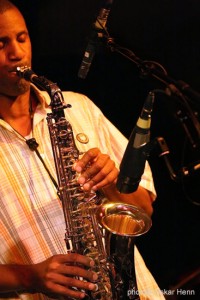
Saxophonist Evan Tate moved from the United States to Germany and has performed in many places around the world. He also teaches saxophone.
(Neal) Q:When and how did you start playing saxophone?
(Evan) A: My father was a musician (pianist, arranger) and was frequently on tour. He picked up jazz albums every once in a while travelling and brought them home. One day, when I was 11 years old, he brought Thelonius Monk’s Greatest Hits, a compilation album. I got turned on right away to the tune “Little Rootie Tootie” and loved Phil Woods’ solo on it. I started playing saxophone at the age of 12, when I entered into junior high school. My first choice was alto saxophone and my second choice was tenor.
Q: Which players have influenced you?
Aside from that solo from Phil Woods, Sonny Rollins, Charlie Parker, John Coltrane, Cannonball Adderley, then later Steve Grossman, Micheal Brecker, Dave Sanborn, Maceo Parker, Steve Coleman, and more.
Q: What kind of band are you playing with now?
A:I have now a “classic” jazz quartet. We play my compositions which range from through-composed experimental stuff, tunes based on standards, and re-arrangements of a couple of standards in odd meters.
In past years, I’ve had a trio with just drums and bass, and also type of fusion band with bass/e-bass, guitar and keyboards, along side the drums and myself.
Q: What have your favorite shows to play been?
A: I like playing in Austria and Switzerland along with performances in Germany. We may be performing in China in the future. Conditions and arrangements are still being discussed.
Q: What horn are you playing and what horns have you played before?
A: I’m playing Julius Keilwerth SX90R Black Nickel Alto sax. I’ve had black pads placed in my horn, not merely for cosmetic reasons, but the pads don’t stick as much as the normal brown pads. I formerly played a Selmer Mark VI (1957) alto. I still have it and it’s still a great horn. Sleek and elegant. It was my first real horn. I got that when I was 15.
I’m also playing a Keilwerth SX90 Soprano sax, nickel-plated, gold lacquer. Keilwerth doesn’t make this combination anymore (nickel-plated, gold lacquer) for their sopranos. I had it especially ordered because of the sound. I had also played a Selmer Mark VI soprano, but I unfortunately didn’t get a good one. I was in college then. I was buying the horn on lay-away from a dealer in Virginia at the time. By the time I had it paid off and had it in my hands, I really didn’t have much experience with buying a horn. I was never really satisfied with it. I tried many others, but I wasn’t really ready to switch though. After holding the Keilwerth in my hands, I knew right away that that was the horn I wanted to play.
Q: What’s the story of your first ebook on saxophone?
A: Well, the very first ebook was the “Way To Mastery Workout Book”. That was actually a product (as also my 2 CDROMs) of the Saxophone Workshops I’ve done in cooperation with Julius Keilwerth. I had always gotten good feedback from the workshops and handed out materials for free. Eventually people started emailing me with questions. So, I figured I would compile most of the exercises/techniques into a book and make it available for sale.
Q: What is the goal of the books on saxophone that you have written?
A: Well, on the side of jazz improvisation, I want to offer an alternative method to the “Chord/Scale Theory” of improvisation and spread the technique of “Jazz Etudes/ Improv Etudes” that I originally learned from Steve Grossman, as a more effective approach to learning improvisation or improving what one has built on already, and accelerating your learning.
Q: Why do you play saxophone?
A: It’s the voice of choice for me. It is with this instrument that I hear myself expressing my best ideas and influences. I play flute and clarinet as well, but the sax is that instrument that has become part of my body. I have the most intimate relationship with it.
Stand by me, the Ben E. King classic. With tracks from people around the world.
It starts of with Rodger Ridley from Santa Monica, California.
Then throws in a bit from New Orleans’ Grandpa Elliot, the blind singer from the French Quarter.
And continues around the world, laying down tracks.
Even a little alto sax towards the end.

Want to play saxophone, but feeling lost and not sure how to get started?
In this online/downloadable class you will see methodical lessons in a sequence and you can get feedback and ask questions at any point.
Learn more
Want to take your playing to the next level?
You’ll learn fundamental saxophone skills, building past the basics. Master rhythms. Learn about phrasing, tone, and more. Here you will get feedback which is crucial to developing good habits.
Learn more