Question:
Received this question the other day about the key of saxophones.
“Are all saxophones in E flat?”
-Emmanuel
My response:
Tenor sax and soprano sax are both in the key of Bb.
Question:
Received this question the other day about the key of saxophones.
“Are all saxophones in E flat?”
-Emmanuel
My response:
Tenor sax and soprano sax are both in the key of Bb.
Started teaching a new student saxophone, Maria. She has been playing for a few weeks now.
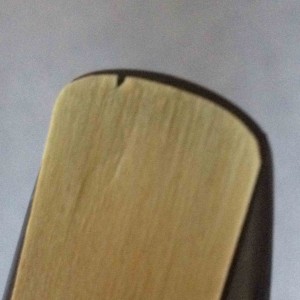
The a few days ago she was having more trouble playing, seemed to give her a headache. So I checked out her mouthpiece and reed and saw a small chip. I could still play it, but it was more difficult. She had been careful with the reed, but that happens sometimes!
And for someone just starting, it becomes a lot harder to play like that!

You want to be very careful with reeds, since even a small chip will make it harder to play!
And you should have some backups in case this does happen. Reeds don’t last forever either, so you want backups.
Generally, you’ll want a number 1.5 or 2 in the first months of playing saxophone. Maybe even the first year. After a year, 2 or 2.5 should be fine.
You may want to move up to a 3 or 3.5 at some point, depending on your own preference.
It also depends on the mouthpiece you use.
It’s good to support local music shops, so you can get reeds there.
You can also order them in boxes.
Rico, Vandoren, La Voz are decent, especially early on. I play on Ricos these days again, just like I did in my first year of playing. Have tried different kinds, can be good to experiment.
Early on though, it’s not going to make a huge difference in how you sound. So you don’t really need the best reeds, you just want ones that are good enough.
1.5 and 2 Rico reeds for alto sax:
Rico Alto Sax Reeds, Strength 1.5, 10-pack
Rico Alto Sax Reeds, Strength 2.0, 10-pack
2 Rico Reeds for tenor sax:
Rico Tenor Sax Reeds, Strength 2.0, 10-pack
A few other things that are good to have:
Alto sax:
Hodge Alto Sax Silk Swab
Tenor sax:
Hodge Tenor Sax Silk Swab
First note on alto sax is a C#. That note repeats five times.
Total of five different notes in the horn line.
I play it in the lower octave here, you can play it up in the higher octave if you would like.

First note on alto sax is a G#. That note repeats five times.
Total of five different notes in the horn line.

Question:
Hi Neal, Is there always some discomfort in your bottom lip from your teeth digging in, I am finding after practicing for 40 – 60mins my bottom lip is pretty tender.
-Brett
Neal:
That depends on how exactly you’re playing.
I think I used to have more discomfort in my bottom lip from the same thing happening. But some time back, I began to somewhat stick my bottom lip farther forward.
Sounds like you’re also applying more pressure than is needed.
So try curling your bottom lip a little less and using a bit less pressure. It will feel different at first, but probably a better way to play in the long run and with less pain.
By Neal 2 Comments
Question:
I play a cannonball alto sax and like most or all saxophones, on the top of the body of the sax there are two screws that you are supposed to tighten up in order for the neck piece not to move.
One of the screws on my sax broke and my neck piece moves around but I can still play normally like I used to. It’s as if no screws are tightening the neck piece.
My question is will this affect my sound?
-Miguel
Neal:
Short answer: yes.
Longer answer has to do with understanding what both of those screws does.
One of those screws tightens the connection with the neck. The other does something else.
It sounds like the one that did not break is the one that does something else.
That screw, from what you have said, sounds like the screw that tights the hold on a lyre. Is the screw going into a small square shaped slot? If so, that’s probably what it is.
A lyre, for anyone does not know, is sort of like a small music stand that you can attach to your saxophone. It’s used in marching bands many times. You can attach a small book of music with it to your saxophone so that you don’t need a full music stand. That means you can move around and march. Although, most marching bands eventually memorize their music I think.
That screw is for a lyre, not to tighten the connection between the sax neck and body.
The connection between your sax neck and the body of the horn is important, you want it to be a good connection. It can affect your sound in a bad way if it’s too loose. And you could potentially damage your instrument by tightening too much.
What I would suggest, for now, is taking the screw from the lyre holder and replacing the screw that does in fact tighten the connection with the neck.
You very well may want to replace the broken screw and have both screws functioning in those two places. Whether the lyre holder is important depends on whether you use a lyre or not.
But the screw that tightens the neck connection is very important, that will affect your sound.
Question:
I’m a new sax player and my teacher recommends I play the mouthpiece
and head for two weeks. Is that necessary to start playing?
-Tobi
Neal:
That would make you focus on one thing, which is trying to get a better tone and playing around with control. That is something you really should do, but it becomes easy to shift your attention to your fingers once you have the whole saxophone and then the tone may get overlooked for a while.
Once your fingers are involved, they are directly linked to your sound. So how you move your fingers can cause problems with your tone.
If your fingers aren’t involved at first, your tone is controlled by your breath and embouchure which are two important elements of playing saxophone.
Doing what your teacher recommends also may help show you the importance of focusing on one thing at a time while learning to play.
By Neal 9 Comments
Question:
How long will it take me to play all sax scales?
(Currently can play “nil” major scales)
A few other people have said they know zero of the major scales.
Response:
How long it will take you to learn the scales on saxophone depends on many things.
They include whether you have played instruments before, how much you practice, whether you have a teacher, etc.
But probably the best way is to learn one scale and then see how it goes and how long it takes.
I would say half the scales will take approximately as long as it takes to learn the first scale. The other half will probably take half that time.
There are similarities between scales.
For example, the difference between C major and G major is one note, the F#.
If it took you a very long time to learn your first scale, it may take quite a bit less time to learn another scale.
Once you have learned a few scales, it’s probably going to be more accurate that the next one will take about as long as the previous one.
What do you think? Let me know what your experience learning scales has been! Leave a comment below.
Great tune, composed by Consuelo Velázquez.
The first part of the melody goes up a scale directly for the first three notes.
On tenor sax, it starts on E and on alto sax it starts on B.
Phillip, who is taking the saxophone improvisation class, asked,
“what are chords?”
Hello Phillip,
I appreciate your help with Sax Station.
Those who purchase lessons and also those that leave comments that are helpful. I understand that not everyone ready/able to purchase lessons.
Realize that if you have played saxophone, even just for one day, what you have to say can be helpful. If you have been playing saxophone for one day, you can help by saying what it was like. For someone who has never played before, the first day can be very confusing. A person may have no idea what they should sound like or how long it will take to sound better.
It’s like a third grader helping a second grader, you can be helpful if you are a few steps ahead of someone.
Here is a page with things you can do to help on Sax Station.
Thanks!
-Neal
Saxophone Foundations:
Structure and feedback and two major elements of improving. Without feedback, it’s difficult to know how to proceed, it’s like driving blindfolded.
You cannot get better unless you develop the foundations of sax playing. I can teach you how to master these techniques.
That’s what the Saxophone Foundations Course is all about. Its a proven way to focus on the most important techniques that will make you a better player, sooner rather than later.
For people just starting with saxophone (if that doesn’t describe you and your abilities seem beyond the level of this class, that’s fine, you may have progressed beyond that point. Something like Saxophone Tribe (link below) might be more appropriate for where you are with the horn. But if you do need to work on fundamentals, I would highly recommend checking out the class.
This is what my students say about the course:
Alicia, said this about the Foundations course,
First of all, I have to say thank you for being a present and available teacher and not an invisible one . . . meaning, you just didn’t sell us the membership with the lessons but you also made yourself available to your students to answer their questions and give personal feedback and you stay in touch. That is tops in my book and I so much appreciate that. So, Thank you.
-Alicia
So stop waiting to get better, off you go, click here.
https://saxstation.com/saxophone-foundations
If you’re past the beginning stages (first two months of playing), check out Saxophone Tribe:
http://saxophonetribe.com/so-you-really-want-to-learn-how-to-play-saxophone

Want to play saxophone, but feeling lost and not sure how to get started?
In this online/downloadable class you will see methodical lessons in a sequence and you can get feedback and ask questions at any point.
Learn more
Want to take your playing to the next level?
You’ll learn fundamental saxophone skills, building past the basics. Master rhythms. Learn about phrasing, tone, and more. Here you will get feedback which is crucial to developing good habits.
Learn more