Leave a comment with what you think the song is!
“We are debating about transposing an alto sax into a standard “c” tuned guitar that is playing in the key of “F” …
Question that I received about transposition for alto sax.
Hi Neal
Please can you help me out, I am having a very heated debate with a soon to be ex friend lol… We are debating about transposing an alto sax into a standard “c” tuned guitar that is playing in the key of “F” …
I say the notes i need to play are: C# E F# G AB C C #
He says that I need to play : D E F# G A B C# D
Please can you let me know who of us is the idiot
Many thanks and kind regards
Matthew
If the guitar is playing in F, that means D on the alto sax.
Just like an Eb on the guitar would be a C on the alto sax. Eb to C is down a minor third. F to D is down a minor third.
It sounds like your friend is right.
You wrote, C# E F# G AB C C # though. I see two sharps and both C and C#…. I don’t understand what you mean by that. How did you get to those notes?
-Neal
Basically I was saying that after having given it some thought I was probably wrong and felt like an idiot, now that you have confirmed it, I really feel like and idiot lol
Basically the way I had worked it out was I wrote down the c scale, bad worked out what I would have to play on the sax to get that, and with that sax “c” scale, I started at F and made everything there on 3 half steps down, where as I should have taken the f scale and done that, but yes I feel silly now haha
Thank you for your help
Regards
Matthew
You just got mixed up about how transposition works, but since you had this debate with your friend, I think you will probably remember it well from now on!
-Neal
“Got Rhythm?” Game, “can you keep the rhythm when the beat drops out?”
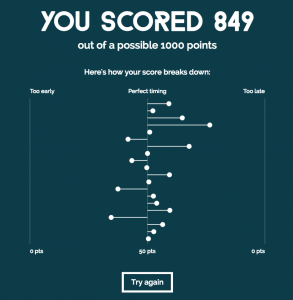
Charles McNeal mentioned a new rhythm game the other day, figured I would try it.
It’s called “Got Rhythm” with the subtitle, can you keep the rhythm when the beat drops out?.
Click here to play “Got Rhythm“
So you hear downbeats and tap either a keyboard or a phone on the downbeats. Then the audio drops out and you need to keep tapping with no sound.
After a couple of tries, I got 849, I like how it breaks down how late/early it is. But at the same time I think it’s a little goofy you click but don’t hear a drum sound.
Also saw the scores of a few people who also tried it out,
890
840
921
864
804
0 (tapping randomly)
738
912
892 (had been using an app called drum genius quite a bit)
849 (me on computer)
906
900
484
820, 877 (after two attempts)
866
Some of the higher scores were probably drummers. A few not though. As a saxophone player, you want to also be able to keep great time. If you think about a sax player like Cannonball Adderley, he very much did that. Michael Brecker could keep a beat on the drumset.
This game only takes about 15 seconds to play and it’s kind of fun to see how well you do compared to friends.
I personally prefer the Dance of Fire and Ice Game, I think it’s more fun and it has off beats. I do like this one though since it’s simple and shows whether you’re early or late with some degree of precision.
Told someone about this game (beginning music student) didn’t go so well on a phone. I thought it might have been because of the phone, but it’s not. I got similar or higher scores on a phone.
That’s cool it does work on many devices, considering that so many people use phones/tablets/etc. The Dance of Fire and Ice game is available for only androids and computers.
So try it out!
If you’re interested in a class on rhythm, fill out this form
How to Play New Thang on Alto Sax (Notes for Tenor Sax below)
Tenor Sax Notes
The notes for tenor saxophone are A, C, E, D.
Like for alto, you play only the A, C, E for the first part. Then you play the D six times at one point.
Rhythm Game, A Dance of Fire and Ice by fizzd
The other day I found a rhythm game online that I like quite a bit.
 The creator made it for a contest with a 48 hour time limit.
http://fizzd.itch.io/a-dance-of-fire-and-ice
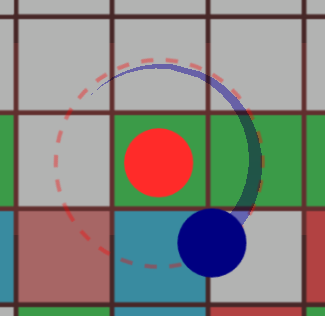
It’s a different sort of concept. Two circles, one red and one blue, orbit around each other. You press one button on the keyboard to make a circle stop on the next square. If you miss the square by being late, you restart. You hear music that tells you what the tempo and the patterns of squares correspond to the music.
The first level consists of a straight line of blocks. What ends up happening is that have an orbit, 180 degrees (π radians) is a single beat.
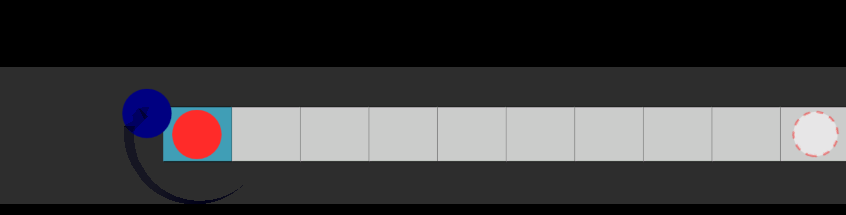
So for this level, you press the button for quarter note values on each beat.
Later on, there are other patterns where the boxes are closer to each other. In those cases, you have different rhythmic values.
Basically, there are eight boxes surrounding one box. A complete rotation is two beats. Half a rotation is one beat.
Within the half rotation there are four options, so one beat split into four becomes sixteenth notes.
There are also points in the game where you rotate 270 degrees, with a dotted quarter note value.
The game switches between downbeats and upbeats starting pretty early on.
The tempo also changes and there are elements which change the orientation of the ‘maze’ as well as slowing down and speeding up the tempo. The final level of each world is significantly harder than the earlier levels.
So far, I have gotten to the final stage of world 3.
You can check out a video of me playing through the first world. I make a few mistakes. Should give you a sense of how the game works.
Internal Rhythm vs Saxophone Rhythm
You have a sense of rhythm inside yourself which can be more or less directly applied to different things.
Talking/singing is fairly direct. As is drumming or playing a one button game like this.
With the saxophone, you often need to press many keys perfectly in time. And the keys are not built equally. Sometimes you’re pressing and lifting fingers simultaneously. The keys also have different amounts of resistance.
So even if you have perfect internal rhythm, it will take some training to transfer that rhythm to the saxophone. That involves the development of technique and learning your instrument very well.
If you’re interested in a class on technique, fill out this form to stay updated
Random Person Picked Up My Saxophone at a Wedding…..
 I played a wedding on Saturday night with a band I’m in. During the first break, I saw a group of people go over to where we were playing, where all the instruments were…….
Sometimes people go over to the microphones to make speeches, announcements, etc. Usually that’s fine. I try to make sure my saxophone is out of the way so it won’t get bumped. You want to be aware of that possibility, especially if people somewhere are drinking.
However, this time, there were a LOT of people where the band was playing. And then…. I saw a girl pick up my saxophone, the wrong way, and hand it to another girl. I instantly went over to them, grabbed my saxophone. And then I began telling them why you NEVER pick up someone’s instrument without their permission. Apparently, the same group was picking up some guitars and other things. I was focused on my instrument. Partly because it can be one of the most delicate if you handle it the wrong way.
The group had picked up the trumpet, I told them to put it down as well. The trumpet player actually saw the people picking up the guitars and told them they should not be doing that. Apparently the group wanted to take a ‘funny’ picture…… without realizing the damage they could do. After that, I carried my saxophone outside for the rest of the break. Checked the neck, seemed like it wasn’t damaged. But that was a situation where it could have been.
The unexpected
That had never happened to me, so I wasn’t really expecting it. But reminded me that I should be aware of my instrument at all times when it’s out. Would have been much safer in the case, but you wouldn’t think you would need to do that.
It’s important to handle your saxophone with care.
Picking up/setting down
You want to pick it up and set it down the right way especially. Picking it up by the neck, grabbing the metal rods in the wrong way, all things that can harm your instrument.
I pick it up either by the bell, which is a large solid piece of metal or with the thumb rest and holding the keys like you would normally hold the saxophone.
How you pick up and put down your saxophone is an important part of maintaining your saxophone. I wrote about maintaining your saxophone a bit the other day in a different post, but thought I would share this story as well.
Heard another story about how a wall fell on a really nice baritone saxophone one time.
Bottom line is that your saxophone will be safer if it’s out the way. And even though it takes a minute, you may want to put it away in the case during a break if you leave the stage.
“What do I need to do to maintain the sax?”
 What do I need to do to maintain the sax?
-Sandy
My response
The most important things you can do to maintain your saxophone happen before and after you play it.
And while you are playing your saxophone do not eat anything or drink anything besides water.
Before playing saxophone you should have some time after you have eaten and you may want to brush your teeth before you play. Sugar and other things in food and drinks are not good for the pads on the saxophone and can cause problems.
While you play, drink water.
After you play your saxophone, I recommend swabbing the saxophone with a cloth or silk swab with a string on it. I do not recommend the fuzzy sticks since they can break down and stay in your horn. I use a separate smaller silk swab made for clarinets for the neck and mouthpiece.
You can also leave your saxophone out on a stand to dry if it’s in a safe place. Depends a bit on the humidity and environment.
Placing a saxophone that has a lot condensation inside a case is not a great idea.
You probably should get your saxophone checked by a repairman about once a year. They have tools such as leak lights to check pads, oil, etc. A few things you may be able to take care of on your own, but only if you know what you’re doing. Small adjustments to the saxophone can cause big problems if not done the right way.
“I seem to have trouble (on saxophone) ….. when I transition to the octave key….from C to D like in a scale run “
I seem to have trouble with a D when I transition to the octave key.
All other notes are fine. I can play the D by itself. And its from C to D like in a scale run.
I’m pretty sure the problem is me.
-Dustin
My response:
This is a great question! It allows us to look at why certain transitions between notes on the saxophone are ‘harder’ or give us trouble.
And yes, the issue is with you and your fingers.
Let’s look at how your fingers move from C to D.
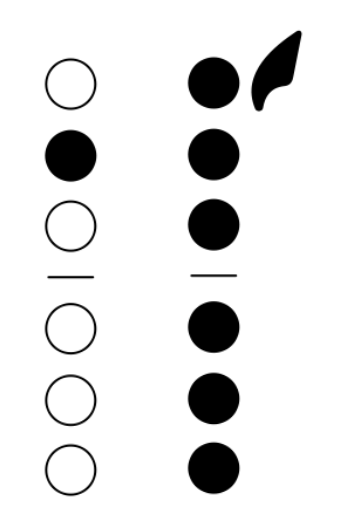
C and D on saxophone
So the middle finger on the left hand stays pressed and six other keys, involving six other fingers, are then pressed. One of those keys is the octave key, which ends up being somewhat significant.
Transitioning from A to B means pressing a single key. Little room for error.
When you press six keys, you need to press them all at the same time. If you rush or drag with any of the movements, you can cause problems.
Part of what you want to do is figure out which of your fingers are early and which are late. If you’re having trouble going between C and D, it almost definitely means that at least one of your fingers is early or late. Slowing down as you play this will help you figure it out.
If you are interested in learning more about technique on saxophone and/or have a question, use this form.
“I have difficulty playing low C (on saxophone) and below without squeaking or not getting a sound”
 I have difficulty playing low C and below without squeaking or not getting a sound. I always try to loosen my embouchure but it is not consistent.
I play an Alto sax with a 1.5 Vandoren reed. I have been playing sax for two years and recently passed Grade 2 exam. Can you give me some tips/exercises that will help to overcome the problem.
(Playing alto sax for two years, practices 3 or 4 days a week)
-Barrie
My response:
Hello Barrie,
Great question. Playing the low notes on saxophone, especially at a low volume can be a little difficult. Something that many of us have to work on. And they tend to be a bit harder on tenor compared to alto.
It’s actually useful that you told me what size reed you are using since that can be a factor with low notes and high notes. Since you’re using a 1.5 reed, that should be fairly soft. And in general, it is easier to play low notes on a softer reed (and a bit easier to play high notes on a harder reed).
It’s possible your saxophone has some leaks, in which case you should get it checked out and possibly fixed. Any leaks in your horn compound and will be most noticeable in the low notes. And with some horn/mouthpiece combinations it can be easier to play than others. But for now, let’s assume your saxophone is in good shape.
I would say you should practice sustaining the low notes. Might need a little more air than other notes.
It often is easier to move from another note to the low notes that are more difficult. So you could start on low D and move down chromatically. Try doing this at different volume levels. It will be more difficult to do softly, but you can develop more control by doing so. Do not slam the keys down at any point, maintain control of your fingers. Keep them curved and move them as little as possible.
And one thing you should pay attention to is the attack. You should not attack these notes in a way that is a lot different than other notes. You want them to feel like any other note. So don’t change your embouchure too much for the low notes.
After practicing transitioning to the the lower notes, you eventually want to be able to play them on their own without problems. Focus on them some in your practice time.
And practicing every day will help a lot of problems get better.
“My question is about breathing during playing alto sax”
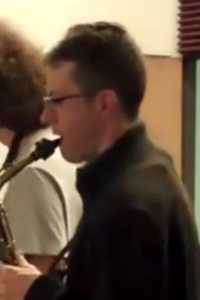 My question is about breathing during playing alto sax. Here the possibilities I think about/saw in some videos.
1. Open the mouth between upper teeth and mouth piece.
2. Open the mouth between reed and lower lip.
3. Open the mouth at the sides.
Another thing that I am doing these days is that I do not open the mputh at all but instead move the sax up and down during playing and somehow I could breath this way very well. Is this correct? or should I opt from above points a right method?
Many Thanks.
-Pranshu
Sounds like a bad idea to me to not open your mouth and move the saxophone. If you move the saxophone, you can potentially change the sound quite a bit. You move it in one direction and then move it back I imagine. That can disrupt the sound.
Most of the time I think I take the first approach you listed,
1. Open the mouth between upper teeth and mouth piece.
By doing that, I keep my bottom in the same place on the reed. Shifting that position can cause problems.
You can see how I breathe fairly clearly on the video on this page, https://saxstation.com/alto-sax-solo-over-red-clay-neal.htm
-Neal
“How can I play the high notes (Eb, E, and F) (on saxophone) without squeeking?”
How can I play the high notes (Eb, E, and F) without squeeking? 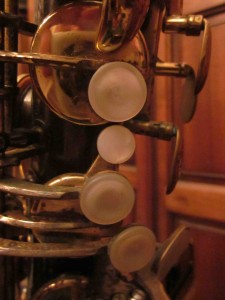
-John
Do you always squeak on the high notes or only sometimes?
-Neal
Only sometimes. I discovered yesterday that if I set the reed with just a smidge showing above the mouthpiece that the squeeks almost disappeared.
-John
Cool, yes, the position of the reed can make a big difference. Glad you worked it out
 -Neal
-Neal