I’m 68 does that make a difference?
-Alan
My Response:
Starting at 68 should be fine.
Can you tell me why it would be a problem?
Check out my beginning class if you are interested in learning from me and are getting started,
Thanks
-Neal
I’m 68 does that make a difference?
-Alan
My Response:
Starting at 68 should be fine.
Can you tell me why it would be a problem?
Check out my beginning class if you are interested in learning from me and are getting started,
Thanks
-Neal
Question:
How do i play without being flat? when i play with a backing track in D (made for guitar) and use the D blues scale to improvise, every note is a whole step flat. is my sax out of tune?
-Jordan
My Response:
You are probably not a whole step flat.
Try playing the E blues scale when you play with the track in D. The tenor sax is in the key of Bb so every nite is shifted by a whole step. The shifting of the notes is called ‘transposition’.
If you don’t account for that, you would be in the wrong key if you try to read music written for piano, guitar, flute, etc. Those instruments are in ‘concert pitch’. The saxophones are not (except the somewhat uncommon C melody).
The alto saxophone is a minor third away from the note displayed on the tuner. If you play ‘C’ on alto sax, it will display ‘D#’ or ‘Eb’ etc on the tuner.

Hi. I am in the sixth grade. b day band. my teacher says i am a good player but needs to improve on some things. He said I need to learn what a overtone is. What is a overtone?
-Marissa
My Response:
Regarding your question about overtones, you can watch this video that I made to get an introduction,
https://saxstation.com/basic-
Thanks
-Neal
By Neal 2 Comments
A while back I was taking some music classes, I started writing a list of songs that I mostly know, somewhat know, or would like to know. When I began learning saxophone, a lot of emphasis was placed on reading tunes. These days I am playing more things by ear and trying to have more to play.
Paul Contos once made up a story about a hypothetical guy who had played third chair trumpet in a symphony for years, but when his friends asked him to play something at home he didn’t have a chart and couldn’t. Don’t be that guy!
Here’s my growing list (in no particular order):
What is the proper way to safely grip the tenor sax when playing C#? Where and how does one grip the instrument?
-Grey
My Response:
(I think you’re talking about C# in the middle of the staff)
Your thumbs go in the usual spots. Right thumb under the thumb rest. Left thumb on the spot near the octave key.
The rest of your fingers should be in contact with the keys as if you were playing a low Bb, but they should not be pressing the keys down.
That should be the way you want to play all the time, without your fingers leaving the buttons as much as possible. For a few notes with the palm keys they may need to leave the keys slightly, but not much.
Your press the keys when you should for the different notes, but the fingers are always in contact with the keys. The fingers shouldn’t fly all over the place. Some sax players do that, but it’s not something that helps how you sound. The way you want your fingers to move is like how Charlie Parker played the saxophone.
Thanks
-Neal
“What scales do I actually need to practice?
I practice major, minor, blues, wholenote, and chromatic in all the keys, but do I need to practice major and minor augmented scales, octatonic scales, the modes of minor and major, and the modes of pentatonic scales? I practice a lot, so it’s no problem how many scales I have to practice, I just don’t want to waste my valuable practice time.”
-Ben
(has been playing for one year,
My Response:
Thanks
-Neal
Feliz Navidad by Jose Feliciano.
Christmas Music book for alto sax
Christmas Music Book for tenor sax
The ‘solutions’ to the music (the notes for this lesson) are listed below the video. They’re not listed all at once though. They’re listed one at a time. You can scroll down to see one and then if you want to check the next one, you’ll need to scroll down farther. In this way, it’s a slight bit of a hassle to check the next note and I would encourage you to not look unless completely necessary.
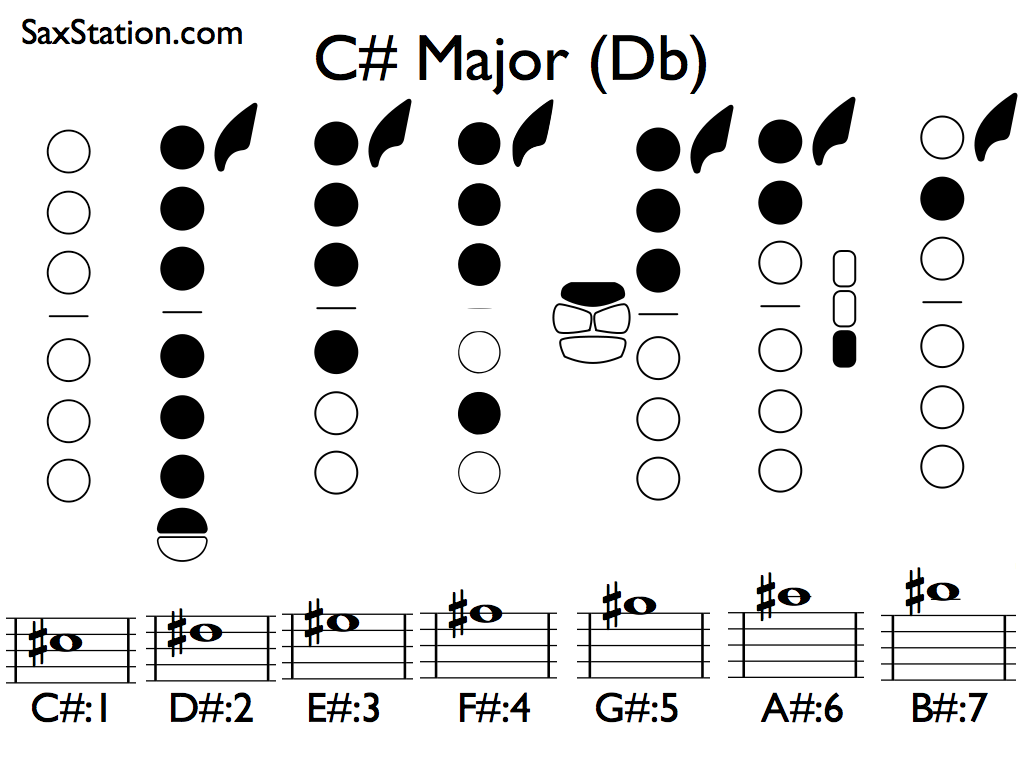
Use the fingering chart if you need to.
Try it out! And let me know how it goes and what you think of the format.
Share it on Facebook and Google + if you like it!
Thanks
First Note
Tenor Saxophone & Soprano Saxophone:
Alto Saxophone & Baritone Saxophone:
.
.
.
.
.
Second Note
Tenor Saxophone & Soprano Saxophone:
Alto Saxophone & Baritone Saxophone:
.
.
.
.
.
Third Note
Tenor Saxophone & Soprano Saxophone:
Alto Saxophone & Baritone Saxophone:
.
.
.
.
.
Fourth Note
Tenor Saxophone & Soprano Saxophone:
Alto Saxophone & Baritone Saxophone:
.
.
.
.
.
Fifth Note
Tenor Saxophone & Soprano Saxophone:
Alto Saxophone & Baritone Saxophone:
.
.
.
.
.
Sixth Note
Tenor Saxophone & Soprano Saxophone:
Alto Saxophone & Baritone Saxophone:
.
.
.
.
.
Seventh Note
Tenor Saxophone & Soprano Saxophone:
Alto Saxophone & Baritone Saxophone:
.
.
.
.
.
Eighth Note
Tenor Saxophone & Soprano Saxophone:
Alto Saxophone & Baritone Saxophone:
.
.
.
.
.
Ninth Note
Tenor Saxophone & Soprano Saxophone:
Alto Saxophone & Baritone Saxophone:
.
.
.
.
.
Tenth Note
Tenor Saxophone & Soprano Saxophone:
Alto Saxophone & Baritone Saxophone:
Check out Saxophone Tribe for more lessons like this!
To sign up for the saxophone ear training class, go to this page
Question:
Hi, I just started playing saxo two months back. and I think I am getting it.
But I do not know how to read saxo music notes, can you please explain?
(has been playing alto sax for almost two months, used to play guitar)
-Rohan Dhammapala (Sri Lanka)
My Response:
This video could be good for you to check out now:
https://saxstation.com/how-to-
After that, check out the fingering chart on this site. It will take a little work to link up the fingerings to knowing what notes they create. But you can get it, just work on a few at a time.
You can get a free sample of my beginning saxophone class at https://saxstation.com/saxophone-foundations
And you can purchase the rest if you would like more.
Thanks
-Neal
“So I started to play alto sax in my beginning band class and i want to impress my teacher any easy songs you can recommend to me that have no sharps or flats… Thank you in advance.”
-Christopher
My Response:
If you go to and get a free sample of ‘Saxophone Foundations’ there is a song without sharps or flats as well as another song with one flat and one more song with one sharp. https://saxstation.com/
-Neal
Is the major scale important for me to learn saxophone?
If so, would you send me the scales that I need to know so that I can learn my instrument.
My mom keeps telling me that’s it’s important.
Can you also send me a fingering chart along with a scale sheet.
-Dave
My Response:
Here is a link to some of them, https://saxstation.com/b-major-
You should get a book to work on. You can purchase my program Saxophone Tribe if you want all of the scales and to work with me and get feedback.
Thanks
-Neal
By Neal 6 Comments
Smooth Operator by Sade and Ray St. John (1982).
Seems like the saxophone found its way into many many songs in the 1980s. Careless Whisper, Baker St, and Smooth Operator is another very famous one.
Played on tenor saxophone in original, I list the notes for alto sax below the video. To play the same notes as tenor, you’ll be starting on low B. Or you could take it all up an octave.
Notes for alto sax:
B C# D E F#
A B C# D C# B A B

Want to play saxophone, but feeling lost and not sure how to get started?
In this online/downloadable class you will see methodical lessons in a sequence and you can get feedback and ask questions at any point.
Learn more
Want to take your playing to the next level?
You’ll learn fundamental saxophone skills, building past the basics. Master rhythms. Learn about phrasing, tone, and more. Here you will get feedback which is crucial to developing good habits.
Learn more