Salson playing ‘Don Goyo’
Ric on trombone/lead vocals
Augie on vocals
Neal on tenor saxophone
Christian on congas
Alex on timbales
Javier on bongos
Kevin on piano
Tony on bass
Salson playing ‘Don Goyo’
Ric on trombone/lead vocals
Augie on vocals
Neal on tenor saxophone
Christian on congas
Alex on timbales
Javier on bongos
Kevin on piano
Tony on bass
Here are some chords you can play as arpeggios (chord notes separately) on sax. The note that stays the same is the root- the root defines the name of the chord. The fifth doesn’t change for all of them. The third and seventh define the sound of the chord.

…gong fu actually means skill that transcends mere surface beauty. A martial artist whose technique is decorative but without power “has no gong fu,” whereas, say, a calligrapher whose work is no pretty to look at but reflects a strong, austere taste certainly “has gong fu.”
(Mark Salzman, pg 30 Iron and Silk
A saxophonist should also have gong fu in his or her playing.
Part of that means, really mastering the basics before moving on. And having a solid foundation beneath any flashy technique.
Sometimes I hear a musician grooving and then they ruin it by playing something fancy that loses the groove.
Mastery of anything involves the same processes, so I would recommend the book Iron & Silk even you don’t study martial arts. And the author, Salzman, also plays cello and he took his cello to China on his stay there.
Using a metronome and starting slowly will help build your skills and make you more comfortable.
Reading properly will help you with improvisation since it will give you quicker access to written music and ideas. It also lets you share your ideas, esp. if you start composing.
To make it your own, you’ll add your personality and your style and maybe even change the rhythms. But it’s important to be able to play music as it was written sometimes, especially when you’re playing with other musicians.
It’s much faster to be able to play music by reading it than playing it by ear, IF you’re a good reader. I’m not saying your ear is not important, however, you want to have multiple tools for music. If you were building a house, you would want a hammer and a saw and probably a lot of other tools. Having a really big hammer wouldn’t make up for not having a good saw.
And think about this, if someone suddenly can’t play a gig and you get called to come in and read some charts, you won’t get the gig if you can’t read well. It will go to someone who might not sound as good as you, but who can read.
-Neal
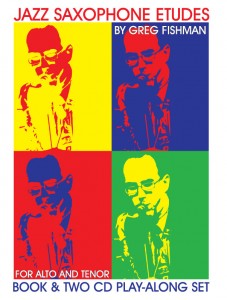
Greg Fishman has written a set of three jazz etude books for saxophone as well as a book on phrasing and a set of duets.
I ordered all five books and have been going through them. They have some cool licks in there, a few of which I have recognized already.
He’s a solid player, I heard him and met him for a minute at the Monterey Jazz Festival.
Greg says,
“This book of etudes was created to fill a gap in the musical resources available to the aspiring jazz musician. Its purpose is to demonstrate the concepts of soloing to those students who know their chords and scales but lack the musical vocabulary to create professional-level solos.
I have written twelve jazz etudes that are enjoyable to play, yet present some technical challenges. However, the technical benefits are secondary to the primary purpose of the etudes: to be able to play through the chord changes in a musical manner while clearly expressing the song’s harmonic structure.
The etudes are based on familiar chord progressions, including blues, rhythm changes, and a variety of common “standard” 32-bar song forms.”
Jazz Saxophone Etudes For Alto & Tenor: Book & Two CD Play-Along Set
Jazz Saxophone Etudes, Volume 2
Jazz Saxophone Etudes, Volume 3
You can hear the etudes played by Greg Fishman and also play along with just the rhythm section.
And the books have some reviews by a few guys you might have heard of…..
“This is really a great book!!!! A powerful sight reading, ear training, swinging, improvising jazz tool. Perfect for the student of jazz.”
––Michael Brecker
“Finally a hip jazz duet book from a sax man who can really play. I recommend this to any teacher who wants to share good music with his students.”
––Phil Woods
“Greg Fishman dares to explore new musical heights. Every lesson in Greg’s books is a must for all musicians, and this latest book is no exception.”
––James Moody

For one, how do you growl and squeal?
-John
Growling is easier than ‘squealing’. You literally growl in the back of your throat, make it rough. It will hurt if you do it too much.
Squealing is known as altissimo and takes a lot of development. To start with, finger low Bb then without changing your fingers play the Bb an octave up and then play G and then play the Bb two octave ups, all without moving your fingers. This is called playing the harmonics and will help you get towards altissimo- which are notes above the normal range of the saxophone.
Altissimo requires you to ‘hear’ the note in your mind and have a lot of control.
-Neal
Plas Johnson played the original sax music for the Pink Panther theme on tenor sax.
Great player, I saw him live a few years back in Carmel, not long after I started playing saxophone actually.
The original tune has tenor on the melody.
I have also played a saxophone quartet arrangement of the Pink Panther Theme, it’s pretty fun. Even played the bari part a couple of times. It’s not a beginning piece- probably would call it intermediate-advanced, a couple parts are tricky.
Pink Panther Saxophone Quartet Arrangement
Pink Panther solo tenor sax music
Henry Mancini wrote some cool music, so if you would like the Pink Panther and some of his other songs, you could get
The arrangements on the CD feature a jazz trio and, in some cases, a full orchestra. All books are compatible with each other and are playable in any instrumental combination. Titles include: Baby Elephant Walk * Breakfast at Tiffany’s * Days of Wine and Roses * Le Jazz Hot! * Moon River * Peter Gunn * The Pink Panther and more.

Harri Rautiainen got the saxophone forum ‘Sax on the Web’ a bit updated.
It’s got the latest forum threads, categories, and jazz musician of the day lined up in a menu on the left side.
Today is Jaco Pastorius, the great bass player, whose birthday it was today.
Here’s Jaco playing ‘The Chicken”
I’ve been on the site a bit, but maybe you have more. Leave me a comment about your favorite thread on the site!
Michael Brecker and Stanley Turrentine on Tenor Saxophones
Bill Evans on Soprano Sax
Ernie Watts on Alto
Don Grolnick on piano
SUZUKI, Yoshio on bass
Adam Nussbaum on drums
Live Under The Sky 89
Thanks to Russ, for finding this
“Talking about music is like dancing about architecture.”
-Thelonious Monk
Dancing can express ideas too! Talking can be more efficient in expressing ideas. If it’s done by people who know what they’re talking about.
Sometimes talking doesn’t really express anything though- think about certain politicians.
You can research music and learn all the theory, but it’s not going to matter until you apply it and bring it into your playing.
So worrying about how to solo isn’t going to be as effective as just doing it.
Learning new things is great, but then apply them to the music!
There are a few good resources for saxophone online
Dave Valdez has some good stuff- http://davidvaldez.blogspot.com
Storm Horn is about saxophone and…. storms.
Craig Buhler talks about sax, clarinet, improvisation. He goes into some advanced stuff.
Helen has a blog at http://bassic-sax.ca/blog/ She talks about traveling with saxophones, players she’s into, and seems to specialize in vintage horns.
And SOTW is the largest moderated saxophone forum.
And of course, if there’s anything I can help you with, let me know!

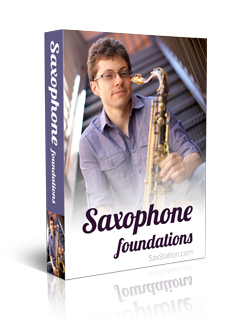
Want to play saxophone, but feeling lost and not sure how to get started?
In this online/downloadable class you will see methodical lessons in a sequence and you can get feedback and ask questions at any point.
Learn more
Want to take your playing to the next level?
You’ll learn fundamental saxophone skills, building past the basics. Master rhythms. Learn about phrasing, tone, and more. Here you will get feedback which is crucial to developing good habits.
Learn more


