If you’re interested in learning more about playing scales, check out the Saxophone Scales Class
Saxophone Scales – “I need someone to explain me those scales. What’s the point? Dooh, why are they so complex?”
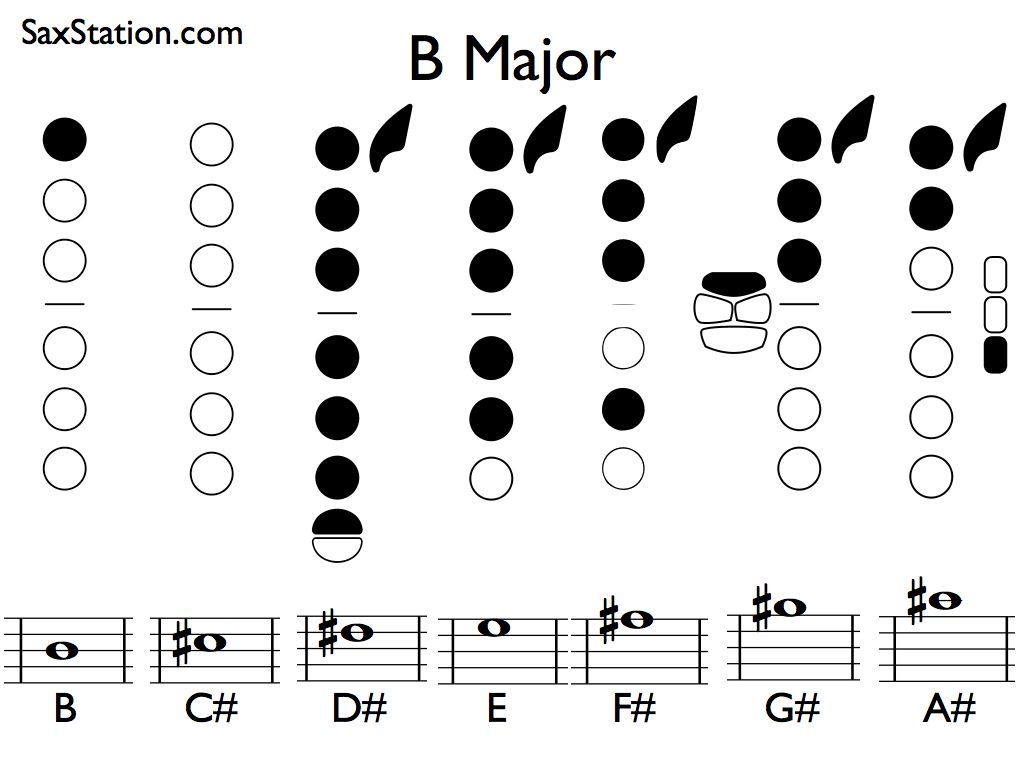
B Major Scale for Saxophone
Question:
I’d love to practise on technique, blowing and notes. And I need someone to explain me those scales. What’s the point? Dooh, why are they so complex?
-Blazka
My response:
Basically music can be played in 12 different keys, each with a different root. And the keys have different variations – major, minor, etc.
Many songs also change key, sometimes multiple times and very quickly.
To be able to play music you need to be comfortable with, for instance, five sharps.
To become comfortable with music that has five sharps, playing the notes in a sequence with five sharps can help you practice. That sequence is a scale.
Playing the notes in that order has a specific sound characteristic of the type of scale. So all major scales have a certain sound. All Lydian scales have a certain sound.
The scale is going to be one of the simplest things you play in any given key.
Music will go in different directions and also include the rest of the elements of music – rhythm, articulation, space, dynamics, etc.
A scale can be practiced with a very regular rhythm.
Getting the movement between notes smooth is one of your first goals when playing scales. You don’t want any awkward transitions between notes or uneven rhythm.
It’s kind of like learning to draw and being able to draw straight lines. You’ll use straight lines when you draw sometimes, but your drawing will also have more complicated shapes, contours, texture, etc.
The skill in being able to draw a straight line will help you be able to draw other things.
Scales are kind of like straight lines in music. In their simplest form, they go straight up and straight down.
Real music sometimes has parts that move exactly like scales. It also has parts that move in different directions with jumps.
-Neal
Saxophone & Scales – 12 or 15 scales?
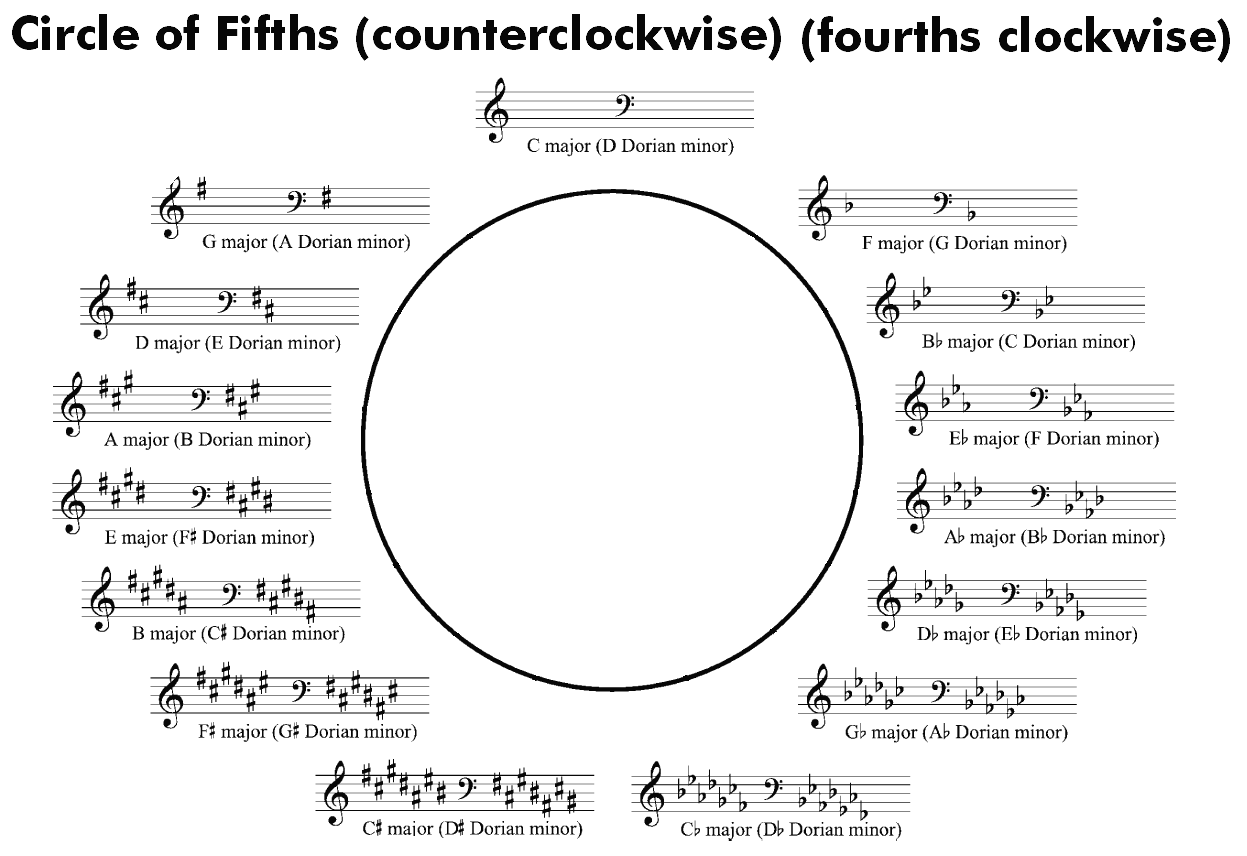 Mark in the Caribbean asked, “One question, how many scales there are 12 or 15?”
To your ear, there are 12 scales. They can be written in different ways though.
You could write a C# scale or a Db scale and it would sound the same, but it would be written differently. Same with F# and Gb.
The are three scales that are somewhat commonly written in different ways which would make it seem like there are 15, but C# sounds the same as Db, F# sounds the same as Gb, and Cb sounds the same as B.
You will see them written in different ways depending on the context. That can make the relationships between scales and chords more clear.
For example, there is no A# in the F major scale, but there is a Bb. So if you wanted to show the relationship of a chord to F major, it would be notated as Bb, not A#. In that way, it is useful to think of there scales in different ways. And then, visually, there would be 15 (or more) scales.
If you imagined you were playing an A# or Bb, it will still sound the same though.
For me, C# seems more comfortable than Db, so if I see Db major, I might think of C#.
But if you just heard the scales, there would be 12.
B Major Scale on Saxophone
Here’s another major scale for saxophone – B major. Has five sharps. F#, C#, G#, D#, A#
B Major Scale for Saxophone
The links to a few others are below. I think I’ll include all these diagrams and possibly recorded examples within Saxophone Tribe and an upcoming beginning class on saxophone.
Saxophone Scales – C# Major Scale
Here it is, the ‘hardest’ scale for saxophone. Generally the keys with sharps are a little less familiar for saxophones than the keys with flats. And C# has a sharp on every note of the scale (all seven). Really, it’s just uncomfortable since we tend to play it …
Saxophone Scales – Ab Major Scale
Here’s the Ab major scale for saxophone. Ab sounds the same as G# and it’s sometimes more convenient to think about it as G#, but generally you want to think about it as Ab. There are four flats in the key of Ab.
Saxophone Scales – How to Play C Major Scale on Sax
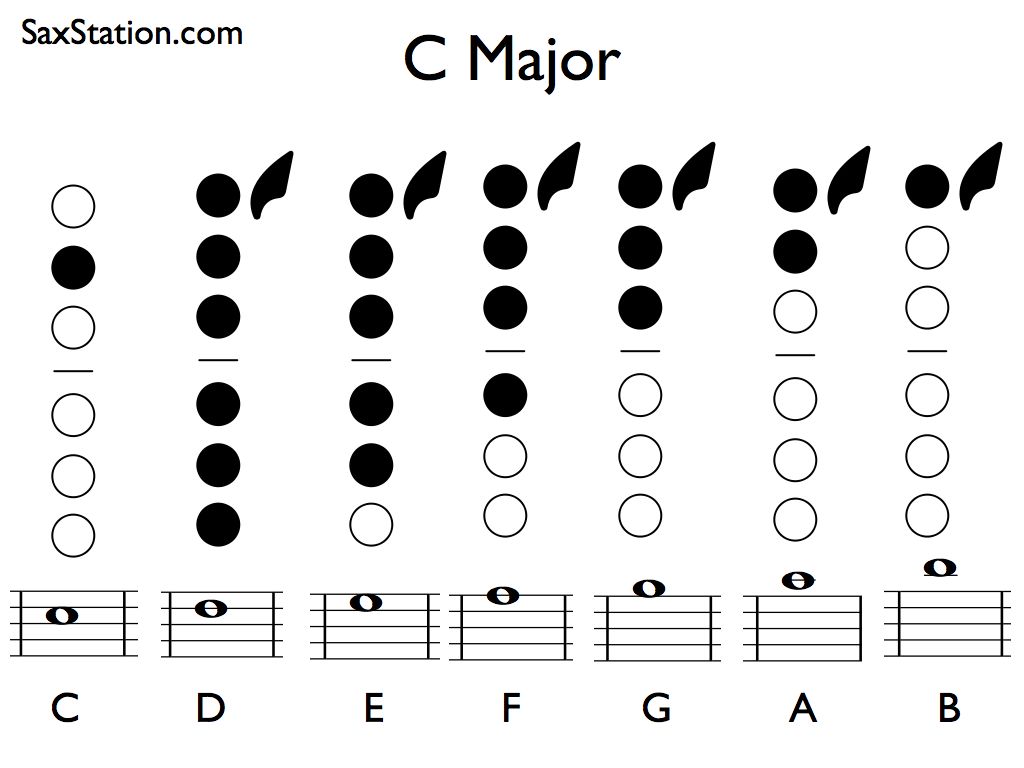
How to Play the C Major Scale on Sax
The C major scale is often the one that we learn the first. Conceptually, it’s the easiest, no sharps, no flats. But it’s actually not the easiest to make sound good.
You can click on the image to see a larger version.
All of the major scales are on Saxophone Tribe.
It’s written out for just one octave here, but you should move into the full range of the saxophone when you’re able to do that.
Moving from C to D is probably the hardest transition within this scale. You’re moving from using a small section of the tube to most of it with the octave key, so those are two fairly different situations. You might want to spend some extra time going between those two notes to make sure it sounds good.
Let me know if you have questions.
Why Learn the Melodic Minor Scale on Saxophone?
 The melodic minor scale…..
It goes one way on the way up and another way on the way down.
Wan asked me the other day why it’s important to learn on saxophone, so I thought about that for a minute. There are reasons…. but understanding why the scale is built the way it is helps to get why you might want to be familiar with it.
Original post was on https://saxstation.com/saxophone-pentatonic-scales-major-minor.htm
Wan:
Hi Neal,
Can you please explain why melodic minor scales are important for jazz improvisation..beside Blues and bebop?
Tq
Neal: It’s a certain flavor of the minor scale, sometimes you want to use that flavor in your sound. Remember that the minor third is what gives the minor scale the ‘minor’ sound though. So you can choose to use the melodic minor or the dorian or the phyrigian or some other variation. Whatever seems to fit in the music and in your idea of what you want to sound like.
You might want to think about why the melodic minor scale exists. It’s one way ascending and another way descending. This makes it more comfortable for singers. On saxophone….. it’s not as hard to do the same thing ascending and descending. So the melodic minor scale isn’t as crucial.
Some melodies might use the melodic minor scale though, esp. if they were written with singers in mind, and if you’re playing it on saxophone it will be useful to have the melodic minor scale under your fingers.
Wan: Thanks Neal
Saxophone Scales – Ab Major Scale
Here’s the Ab major scale for saxophone.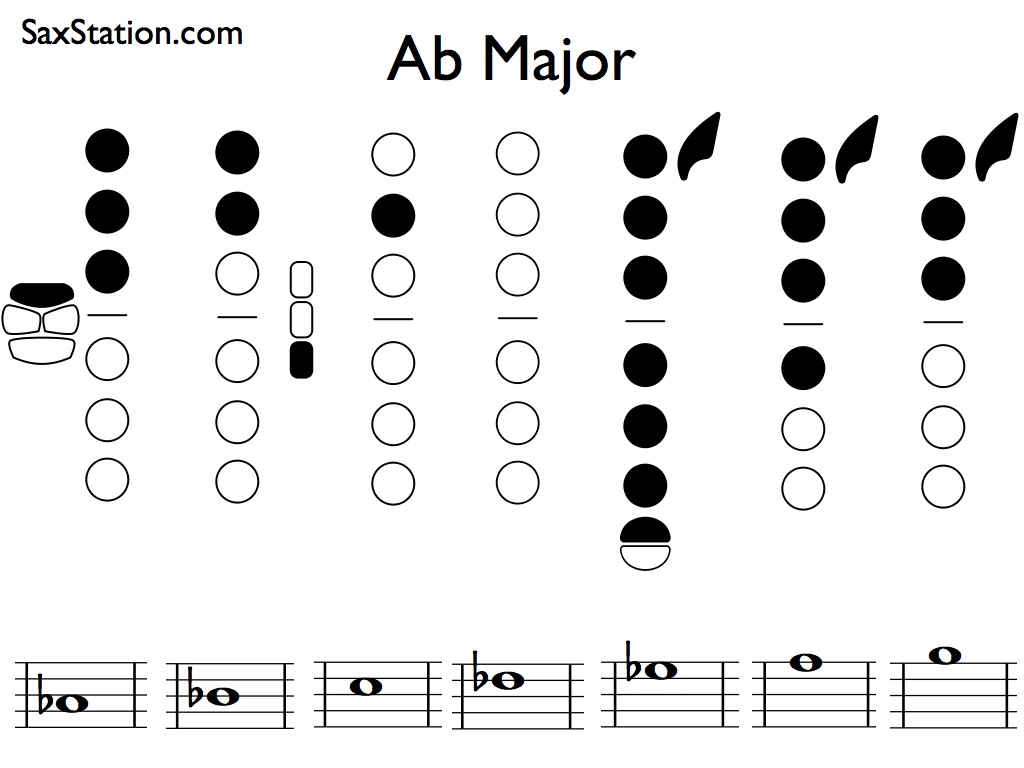
Ab sounds the same as G# and it’s sometimes more convenient to think about it as G#, but generally you want to think about it as Ab.
There are four flats in the key of Ab.
All of the major scales are on Saxophone Tribe.
Here’s a link to my class on scales for saxophone.
And here’s a post about how the notes with letters compare with do re mi fa so la ti do,
“How to play do re mi fa sol la and ti on saxophone”
Saxophone Scales – C# Major Scale
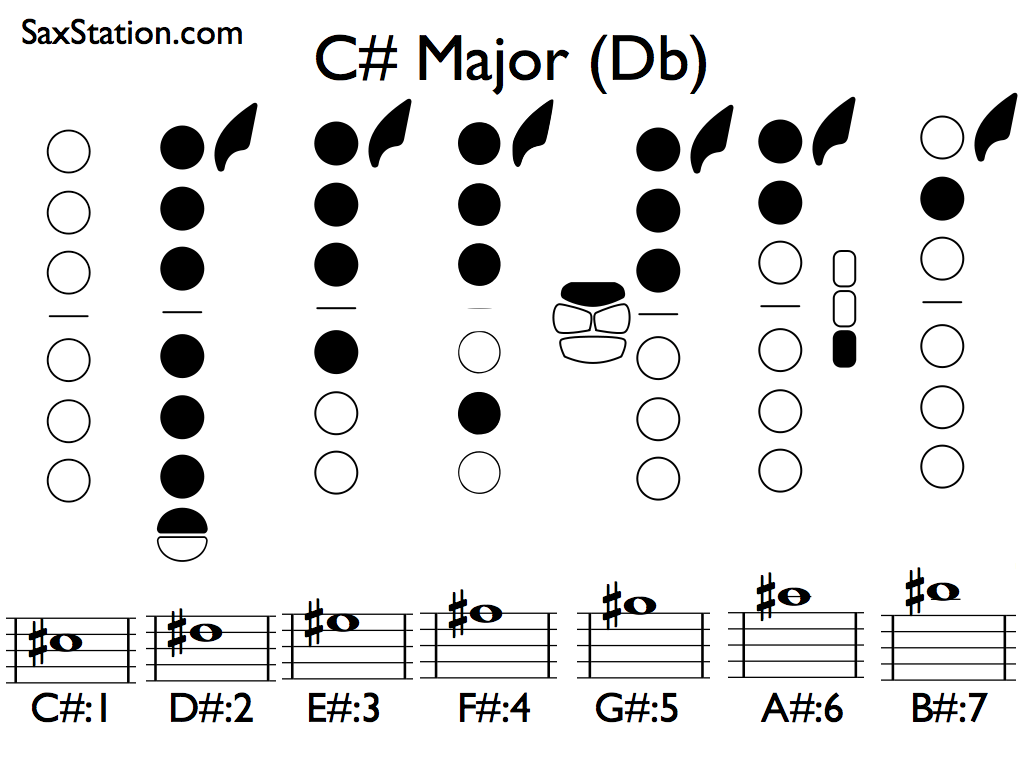 Here it is, the ‘hardest’ major scale for saxophone. Generally the keys with sharps are a little less familiar for saxophones than the keys with flats. And C# has a sharp on every note of the scale (all seven). Really, it’s just uncomfortable since we tend to play it less.
The C# major scale for saxophone.
You can think of it as the Db major scale, it sounds the same and that makes more sense in some situations that way.
All of the major scales are on Saxophone Tribe. They’re also in the class on scales, https://saxstation.com/saxophone-scales-book-class
Let me know if this is helpful. Leave a comment.
Pentatonic Scales for Tenor Sax
The pentatonic scales can be heard in music across the world. They have only five notes, but those notes seem to ‘fit’ well in a lot of places.
Learning pentatonic scales will enable you to quickly have something under your fingers that you can play. The blues scale and minor pentatonic scale are similar.
If you want to play pentatonic scales on tenor sax, to get from concert key (piano, guitar, etc) to Bb (the key that tenor and soprano sax are in) you need to go up a whole step.
So concert Bb is C on tenor sax, concert F is G on tenor sax, etc.
From there there,
The major pentatonic scale is the 1, 2, 3, 5, 6
In the key of C (on tenor sax) that would be C, D, E, G, A
Minor pentatonic scale is the 1, b3, 4, 5, b7
In the key of C (on tenor sax) that would be- C, Eb, F, G, Bb

How to Practice Saxophone Scales
If you’re somewhat new to saxophone, you want to learn all your major scales first. They will act as a foundation for you to relate many other scales in your mind.
Practicing them with a metronome, initially slowly, will help you master them.
Once you know the major scales, you have the basis to play all the modes as well.
Sometimes a few scales can go with a chord. All the modes work- ionion, dorian, phrygian, lydian, mixolydian, aeolian, and locrian work a little bit differently. Some are more useful than others, for instance you almost never use locrian.
Ionian is the same as the ‘major’ scale and can be played over major chords, mixolydian scales can be played over dominant seventh chords, a few of them are minor.
There are seven modes for each major scale. Each mode uses all the notes of that major scale, but they all start in different places.
The ionion mode starts on the root note of the major scale, the dorian mode starts on the second note, phyrigian starts on the third note etc.
Because they start in different places, they have different intervals between the notes and therefore have a unique sound.
Major 1 2 3 4 5 6 7 8
Dorian 1 2 b3 4 5 6 b7 8
Phrygian 1 b2 b3 4 5 b6 b7 8
Lydian mode – 1 2 3 #4 5 6 7 8
Mixolydian mode – 1 2 3 4 5 6 b7 8
Aeolian mode – 1 2 b3 4 5 b6 b7 8
Locrian mode – 1 b2 b3 4 b5 b6 b7 8
If you construct scales based off of these chords, they are as follows
For use with the triad, 7th, 9th, 11th, 13th chords-
Ionian: Maj Maj7 Maj9 Maj11 Maj13
Dorian: min min7 min9 min11 min13
Phrygian: min min7 min7(b9) min11(b9) min11(b9b13)
Lydian: Maj Maj7 Maj9 Maj7(#11) Maj13(#11)
Mixolydian: Maj 7 9 11 13
Aeolian: min min7 min9 min11 min11(b13)
Locrian) dim min7(b5) min7(b5b9) min11(b5b9) min11(b5b9b13
Saxophone Pentatonic Scales – Major and Minor
Got this question from Jeshurun yesterday about scales.
good day neal.. neal may i ask some help? do you know a site that teaches pentatonic scales or chromatic?
-Jeshurun
For a chromatic scale, you just start on one note and go up and down chromatically. Certain fingerings make it easier to play faster.
A pentatonic scale has five notes- in the key of C, C, D, E, G, A. So you take the notes from the major scale and play the root, 2nd, third, fifth, sixth.
A minor pentatonic is somewhat similar, starting on C, it would be C, E-flat, F, G, B-flat. It has the root, minor third, fourth, fifth, and lowered 7th (relative to a major scale).
Knowing your major and minor scales will help you with playing these.