Work Song!
Want to learn how to play Work Song and improvise over it?
Have always loved Cannonball Adderley’s sound. Here is one of my favorite videos with him playing. His brother Nat wrote the tune.
Work Song!
I’ve started looking around for a sax, I really appreciate your recommendations. I found a vintage Selmer and am seriously considering putting something down on it. What do you think I should pay for a good Saxophone or is it kind of hard to say?
-Chris
If you’re just starting, I would probably use a beginning horn. They tend to be a little easier to play on. Depending on the vintage horn though, it might turn out all right. Plan on spending ~$1500 or so for a solid beginning horn. Did you decide on an alto or tenor?
Try it out and bring a saxophone player with you if you can.
-Neal

For a few years I have been using Vandoren V16 reeds. They play pretty well and consistently. And now they even have a spiffy new wrapping that keeps each reed sealed.
Vandoren V16 Saxophone Reeds
The first reeds I played when starting were Ricos and Rico Royals. They cost a bit less, but the cut is not always quite right. The Rico Royals were a little better than the Ricos.
Experimented a bit with Bari plastic reeds and Fibracell reeds. They last a very long time and I keep a couple in my case in case I need them. Between those two I like the fibracell reeds better and I still use them when I pick up my clarinet.
My new mouthpiece on tenor is a Vandoren V16 T9, which seems to work pretty well with the V16 reeds. The 3’s I have been using are a bit too stiff though since the T9 is pretty open, so I’m about to order some 2.5’s. Hopefully they will work better.

Gato Barbieri- latin jazz tenor sax – Last Tango in Paris. Tenor sax solo intro with the group joining in after a bit.
Gato Barbieri CDs
Leandro Barbieri was born November 28, 1934 in Rosario, Argentina and is known to most as “El Gato Barbieri.” He plays jazz tenor saxophone and also composes. In the 1960s he was part of the free jazz movement and in the 70s he recorded latin jazz. Barbieri had a family of musicians and was inspired to play upon hearing “Now’s the Time” by Charlie Parker.
Barbieri started on clarinet and then moved to alto saxophone. He played with Argentine pianist Lalo Schifrin in the late 1950s. After leaving Argentina for Rome he played tenor sax in the early 1960s with trumpeter Don Cherry. Influential players on Barbieri include Coltrane, Albert Ayler, and Pharoah Sanders. His sound has been called “warm and gritty.”
Barbieri brought styles of South America into his music in the late 1960s and his score for Bernardo Bertolucci’s film ‘Last Tango in Paris’ earned him a Grammy and led to a record deal with Impulse! Records.
He was with A&M Records in the late 1970s, and began moving towards jazz-pop on records like “Caliente,” which included his most popular song, Carlos Santana’s Europa.
Gato Barbieri’s Mouthpiece was a metal Berg Larsen and he played a tenor Selmer Mark VI.
The World Saxophone Quartet playing Money in Lovejoy, Illinois.
The World Saxophone Quartet is made up of Hamiet Bluiett, Oliver Lake, James Carter and Greg Osby. Bluiett went to this school and returned to play the concert.
Michael Brecker plays Delta City Blues, there’s a solo saxophone introduction for a bit. He uses multiphonics and overtones heavily in the song. They can be a fun thing to play around with to get different tones as well!
If you like my site/newsletter, please support it at Amazon
I took a jazz improvisation class at the local junior college when I was in high school.
The girl who played piano there was somewhat obsessed over the song “Red Clay” by Freddie Hubbard.
She said that she would always play that song with her combo.
Freddie Hubbard has written a lot of good stuff, but just like any musician you’ll like some things they do, but not everything (usually).
Have listened to it quite a few times and played over it a few times, great song. More recently.
The changes are the same as those from the song ‘Sunny’ by Bobby Heb.
Here’s a video of me playing a solo on alto sax over Red Clay.
One of my favorite ballads, Nature Boy, by Eden Ahbez.
Here’s how to play the first phrase. Played on tenor saxophone in the video. Notes for alto sax written below.
If you would like feedback on how to sound better playing this song, check out Saxophone Tribe.
Alto Sax:
F# F# D B
F# C# D E G
F# D B

Selmer Soloist Mouthpiece, C**
Question about a saxophone mouthpiece and a bit of discussion.
The comments on a few pages were getting a little bit out of hand, so I was thinking I would change the format a bit. Here’s a question, my answer, and a bit of discussion about mouthpieces and equipment.
Go to the Questions? page if you have a question. And feel free to leave comments on posts.
Hélio Lacerda
Hi Neal,
thanks for all the posts and lessons this year and wish a happy new year to you.
What is your opinion on the mouthpiece selmer soloist c **?
That will be formed in my setup to play in the suit of my orchestra?
Our repertoire is mostly jazz standarts and Brazilian music.
Our suit is made by me on tenor sax and flute, a clarinet and two alto sax.
Ihave a Conn 16M tenor, currently use a 7-d dukoff metal and reeds Fibracell.
Regards,
Hélio.
Neal
Hey Hélio,
I think that the selmer soloist would work well for an orchestra. You might need a mic to cut through with the jazz standards and Brazillian music, the main thing is if you’re liking the sound for the setting that you play it in.
The Dukoff is going to cut through more, but maybe the Selmer sounds better. Go with the one that helps you get the sound you like, maybe get the other musicians to let you know what they think.
Your perspective playing is different than their perspective, you can also record both and see what you think.
-Neal
Hélio Lacerda
Hi Neal!
Exact, was the suggestion of the musicians of the orchestra that I’m looking to change my sound. I’ve tried hard rubber Otto Link, but not like the result. I will test a selmer soloist now.
Thank you.
Ken Bourg
Hélio: I also have a 16M Tenor and get my best results on either a Solist D (rubber) or a Selmer Jazz D (Metal) using Legere 2 1/2 or 3 reeds deending on the music to be played. I have lots of other MPs but these are two of my favorites.
I soon plan to buy a Super Session tenor 8. I play almost exclusively on the Super Session E on Soprano (Selmer VI) and Super Session D or E on Alto (Yamaha Custom 875 EX with the V1 neck. Hope this helps. Happy New Year, Ken
Neal
Hello Ken,
Thanks for adding your thoughts on the matter, especially since you’re playing that horn!
-Neal
Hélio Lacerda
Hi Ken!
Thanks for the help. I already buy the Selmer Soloist mouthpiece, I hope the outcome is good.
Thanks.
Ken Bourg
Hélio: Let us know how it works out for you.
I’m always interested in how different combos work out. For example, on my 1947 Martin Imperial Tenor (the backup with metal resos) I use an old Whitehall that measures 2.05 on the tip gauge. It has a very long facing and a huge chamber. It really looks like a Barry MP.
I like Fibracell Synthetic hard reeds on it and I can tease it between light and dark tones and howl like a wolf when I need to really project. On my Yamaha Custom YTS 82 Z Silver, I like the old Selmer Metal Soloist E (no longer in production) with a Legere #3 Signature Series Synthetic reed & Rovner Platinum Ligature. That combo is dynamite for R&B / blues pieces.
I might add that I exclusively use Rovner ligatures on every sax / clarinet MP. I find there is no equal and have about 15 or so that I use either in rotation or for specific tonal needs. Wishing you the best Happy New Year ever; now go out and gig a mob. Ken
Hélio Lacerda
Ken,
In my tenor Conn16M 1967 I use the D-7 dukoff metal with Fibracell 2.5 or 3 and Rico ligature, then the sound is bright. I’ve tried using other reeds but did not like the result.
My friends in the orchestra suggested a darker sound to fit more on the suit, so I want use a selmer soloist mouthpiece to feel the results. I will start using the fibracel and then I tested other types of reeds. I already bought a selmer soloist C**, I’m waiting to arrive.
I never used Legere reeds. Do you like it?
Thanks,
Hélio
Ken Bourg
Hello Hélio: Yes, I am loyal to Legere, especially their new Signature series. I am also loyal to Rovner Ligatures. I like the Dark 2R or Platnum 2-PR (especially to bring out the lower registers) on the Soloist Hard Rubber D with a 2 1/2 or 3 Legere Platnum for a darker sound.
I don’t know what pads you are using, but if you have domed pads with metal resos, you will always be on the bright side with the 16M. The Dukoff will be brighter than the Solist. In all combos. The 12M series were intended to project brightness into pieces and not built as a dark sounding instrument.
I suggest you try a Rovner 2R Dark with a Legere Signiture reed with your soloist. You will darken your sound some. If you are wanting to do serious concert pieces you might consider using a Yamaha YTS Custom 875 EX with the G3 neck. They are built for the orchestra. Good luck. Ken
Softly as in a Morning Sunrise first phrase. Composed by Sigmund Romberg and (lyrics) Oscar Hammerstein II. Try learning the rest of the tune by ear (better option), or you could probably find it in a fake book. Alto sax notes below video.
It comes from a 1928 operetta, The New Moon. Has been covered by Artie Shaw, Sonny Rollins, John Coltrane, Freddie Hubbard, and others.
Alto sax notes:
A E
D E D E D
A C
Played in the video on tenor, if you play alto or bari though, you probably just want to try it using the same notes, starting on C. If you want to play it in the same key as it’s being played, then that first note is a concert Bb, which is a G on alto/bari.
Next note is a half step below that first note, the seventh, followed by the ninth, then the sixth and ends on the fifth relative to the major key.

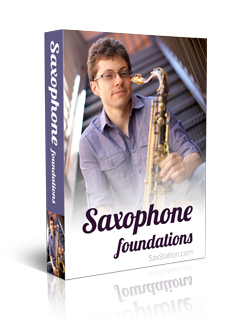
Want to play saxophone, but feeling lost and not sure how to get started?
In this online/downloadable class you will see methodical lessons in a sequence and you can get feedback and ask questions at any point.
Learn more
Want to take your playing to the next level?
You’ll learn fundamental saxophone skills, building past the basics. Master rhythms. Learn about phrasing, tone, and more. Here you will get feedback which is crucial to developing good habits.
Learn more