At Taste Fridays, Space 550 in SF.
Melody composed by John Williams
At Taste Fridays, Space 550 in SF.
Melody composed by John Williams
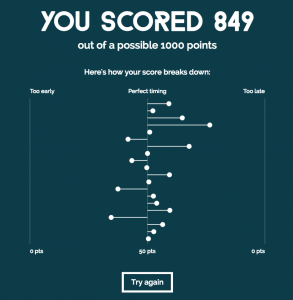
Charles McNeal mentioned a new rhythm game the other day, figured I would try it.
It’s called “Got Rhythm” with the subtitle, can you keep the rhythm when the beat drops out?.
So you hear downbeats and tap either a keyboard or a phone on the downbeats. Then the audio drops out and you need to keep tapping with no sound.
After a couple of tries, I got 849, I like how it breaks down how late/early it is. But at the same time I think it’s a little goofy you click but don’t hear a drum sound.
Also saw the scores of a few people who also tried it out,
890
840
921
864
804
0 (tapping randomly)
738
912
892 (had been using an app called drum genius quite a bit)
849 (me on computer)
906
900
484
820, 877 (after two attempts)
866
Some of the higher scores were probably drummers. A few not though. As a saxophone player, you want to also be able to keep great time. If you think about a sax player like Cannonball Adderley, he very much did that. Michael Brecker could keep a beat on the drumset.
This game only takes about 15 seconds to play and it’s kind of fun to see how well you do compared to friends.
I personally prefer the Dance of Fire and Ice Game, I think it’s more fun and it has off beats. I do like this one though since it’s simple and shows whether you’re early or late with some degree of precision.
Told someone about this game (beginning music student) didn’t go so well on a phone. I thought it might have been because of the phone, but it’s not. I got similar or higher scores on a phone.
That’s cool it does work on many devices, considering that so many people use phones/tablets/etc. The Dance of Fire and Ice game is available for only androids and computers.
So try it out!
If you’re interested in a class on rhythm, fill out this form
The other day I found a rhythm game online that I like quite a bit.
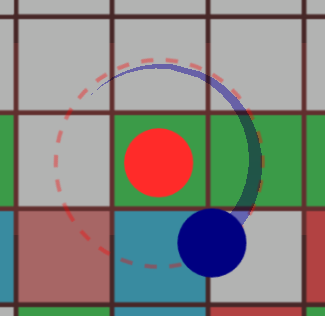 The creator made it for a contest with a 48 hour time limit.
http://fizzd.itch.io/a-dance-of-fire-and-ice
It’s a different sort of concept. Two circles, one red and one blue, orbit around each other. You press one button on the keyboard to make a circle stop on the next square. If you miss the square by being late, you restart. You hear music that tells you what the tempo and the patterns of squares correspond to the music.
The first level consists of a straight line of blocks. What ends up happening is that have an orbit, 180 degrees (π radians) is a single beat.
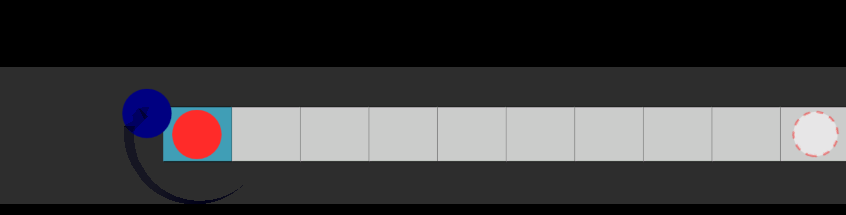
So for this level, you press the button for quarter note values on each beat.
Later on, there are other patterns where the boxes are closer to each other. In those cases, you have different rhythmic values.
Basically, there are eight boxes surrounding one box. A complete rotation is two beats. Half a rotation is one beat.
Within the half rotation there are four options, so one beat split into four becomes sixteenth notes.
There are also points in the game where you rotate 270 degrees, with a dotted quarter note value.
The game switches between downbeats and upbeats starting pretty early on.
The tempo also changes and there are elements which change the orientation of the ‘maze’ as well as slowing down and speeding up the tempo. The final level of each world is significantly harder than the earlier levels.
So far, I have gotten to the final stage of world 3.
You can check out a video of me playing through the first world. I make a few mistakes. Should give you a sense of how the game works.
Internal Rhythm vs Saxophone Rhythm
You have a sense of rhythm inside yourself which can be more or less directly applied to different things.
Talking/singing is fairly direct. As is drumming or playing a one button game like this.
With the saxophone, you often need to press many keys perfectly in time. And the keys are not built equally. Sometimes you’re pressing and lifting fingers simultaneously. The keys also have different amounts of resistance.
So even if you have perfect internal rhythm, it will take some training to transfer that rhythm to the saxophone. That involves the development of technique and learning your instrument very well.
If you’re interested in a class on technique, fill out this form to stay updated
 I played a wedding on Saturday night with a band I’m in. During the first break, I saw a group of people go over to where we were playing, where all the instruments were…….
Sometimes people go over to the microphones to make speeches, announcements, etc. Usually that’s fine. I try to make sure my saxophone is out of the way so it won’t get bumped. You want to be aware of that possibility, especially if people somewhere are drinking.
However, this time, there were a LOT of people where the band was playing. And then…. I saw a girl pick up my saxophone, the wrong way, and hand it to another girl. I instantly went over to them, grabbed my saxophone. And then I began telling them why you NEVER pick up someone’s instrument without their permission. Apparently, the same group was picking up some guitars and other things. I was focused on my instrument. Partly because it can be one of the most delicate if you handle it the wrong way.
The group had picked up the trumpet, I told them to put it down as well. The trumpet player actually saw the people picking up the guitars and told them they should not be doing that. Apparently the group wanted to take a ‘funny’ picture…… without realizing the damage they could do. After that, I carried my saxophone outside for the rest of the break. Checked the neck, seemed like it wasn’t damaged. But that was a situation where it could have been.
The unexpected
That had never happened to me, so I wasn’t really expecting it. But reminded me that I should be aware of my instrument at all times when it’s out. Would have been much safer in the case, but you wouldn’t think you would need to do that.
It’s important to handle your saxophone with care.
Picking up/setting down
You want to pick it up and set it down the right way especially. Picking it up by the neck, grabbing the metal rods in the wrong way, all things that can harm your instrument.
I pick it up either by the bell, which is a large solid piece of metal or with the thumb rest and holding the keys like you would normally hold the saxophone.
How you pick up and put down your saxophone is an important part of maintaining your saxophone. I wrote about maintaining your saxophone a bit the other day in a different post, but thought I would share this story as well.
Heard another story about how a wall fell on a really nice baritone saxophone one time.
Bottom line is that your saxophone will be safer if it’s out the way. And even though it takes a minute, you may want to put it away in the case during a break if you leave the stage.
 What do I need to do to maintain the sax?
-Sandy
My response
The most important things you can do to maintain your saxophone happen before and after you play it.
And while you are playing your saxophone do not eat anything or drink anything besides water.
Before playing saxophone you should have some time after you have eaten and you may want to brush your teeth before you play. Sugar and other things in food and drinks are not good for the pads on the saxophone and can cause problems.
While you play, drink water.
After you play your saxophone, I recommend swabbing the saxophone with a cloth or silk swab with a string on it. I do not recommend the fuzzy sticks since they can break down and stay in your horn. I use a separate smaller silk swab made for clarinets for the neck and mouthpiece.
You can also leave your saxophone out on a stand to dry if it’s in a safe place. Depends a bit on the humidity and environment.
Placing a saxophone that has a lot condensation inside a case is not a great idea.
You probably should get your saxophone checked by a repairman about once a year. They have tools such as leak lights to check pads, oil, etc. A few things you may be able to take care of on your own, but only if you know what you’re doing. Small adjustments to the saxophone can cause big problems if not done the right way.
I appreciate your help with Sax Station.
Those who purchase lessons and also those that leave comments that are helpful. I understand that not everyone ready/able to purchase lessons.
Realize that if you have played saxophone, even just for one day, what you have to say can be helpful. If you have been playing saxophone for one day, you can help by saying what it was like. For someone who has never played before, the first day can be very confusing. A person may have no idea what they should sound like or how long it will take to sound better.
It’s like a third grader helping a second grader, you can be helpful if you are a few steps ahead of someone.
Here is a page with things you can do to help on Sax Station.
Thanks!
-Neal
Saxophone Foundations:
Structure and feedback and two major elements of improving. Without feedback, it’s difficult to know how to proceed, it’s like driving blindfolded.
You cannot get better unless you develop the foundations of sax playing. I can teach you how to master these techniques.
That’s what the Saxophone Foundations Course is all about. Its a proven way to focus on the most important techniques that will make you a better player, sooner rather than later.
For people just starting with saxophone (if that doesn’t describe you and your abilities seem beyond the level of this class, that’s fine, you may have progressed beyond that point. Something like Saxophone Tribe (link below) might be more appropriate for where you are with the horn. But if you do need to work on fundamentals, I would highly recommend checking out the class.
This is what my students say about the course:
Alicia, said this about the Foundations course,
First of all, I have to say thank you for being a present and available teacher and not an invisible one . . . meaning, you just didn’t sell us the membership with the lessons but you also made yourself available to your students to answer their questions and give personal feedback and you stay in touch. That is tops in my book and I so much appreciate that. So, Thank you.
-Alicia
So stop waiting to get better, off you go, click here.
https://saxstation.com/saxophone-foundations
If you’re past the beginning stages (first two months of playing), check out Saxophone Tribe:
http://saxophonetribe.com/so-you-really-want-to-learn-how-to-play-saxophone
A few of my students have thought they were were playing altissimo on saxophone, when that wasn’t really the case.
Notes that use the palm keys are fairly high and may be difficult to play, especially for beginning sax players, but that doesn’t make them ‘altissimo’.
At some point after you have been playing saxophone for a little while, you may hear this word, ‘altissimo’. Maybe it’s thrown into a conversation you hear, something like, “Man, then the sax player hit that altissimo C and it wailed”.
Pretty soon, you start to get the idea that it has to do with high notes.
But how does it work?
Where does it start?
If you use an ‘altissimo fingering’, the note that comes out is not necessarily going to be altissimo. It takes a bit of control and knowing what something should sound like for it to work. That second part especially, if you can hear the note in your mind before you play it, it’s far more likely to happen.
Otherwise you’re aiming blindly.
Where it starts:
Basically, saxophone altissimo starts above high F#. Some might say that this F# is the first note of altissimo.
If you have a high F# key, this note seems more like a regular note, if you don’t and it requires a different fingering, it may seem more like altissimo.
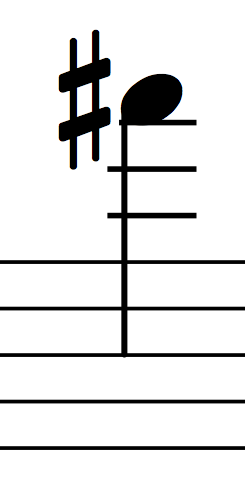
D and Eb use palm keys, but are not altissimo.
The G above that F# is altissimo, as are notes above that.
Depending on your control and skill, you can go up another octave, or two, or more……
Fingerings
One of the funny things about altissimo is that, unlike the usual notes which tend to have a standard fingering, they often have multiple options.
These options seem to work better on alto or tenor and even between brands of saxophone.
You often want to try many fingerings to see which come out the most easily and which are the most in tune.
You may modify the fingerings slightly. Things like putting down the bis key to make it a little lower, etc.
Foundations
Without the foundations though, trying the different fingerings can be fairly useless.
The foundations include a developed ear to ‘hear’ the notes before you play them and a good working ability with the harmonics.
Most important thing ever to learn on saxophone?
No.
Why learn them?
They sound cool in solos, occasionally come up in parts, and working on being able to play them will strengthen your overall tone.
At what point should you work on them?
When it makes sense, so after you have a good sense of rhythm, have a decent tone, know some scales, etc. Probably after you have been playing for a few years and want to add something new to what you can play.
 Got this question about saxophone altissimo the other day. Seems like something that you might be working on too.
Picture of the sky in Kirindiwela, Sri Lanka. Since you’re playing notes up there with altissimo.
Question:
“How to get overtones?”
-Ruben
My Response:
You can check out this video I made
https://saxstation.com/basic-
There is more on overtones/altissimo in Saxophone Tribe.
Basically you start by getting the overtones using the three lowest notes on the saxophone- Bb, B, and C. The first one you want to use is Bb.
You can get overtones from other notes/fingerings, but it’s going to be easiest to start with the low Bb.
Spend a little time working on it everyday if this is something you want to develop. Consistency is very important.
At the same time, find a time and place that you won’t bother people since it won’t sound very musical at first.
Thanks
-Neal
Question:
I was wondering what the normal age a sax player should start integrating altissimo into their improv? I’m 15 and I can hit up to D pretty solidly. I use G-C in my improv most of the time, when it calls for notes that high. I’ve been playing for 5 years now and was wondering if I should be going higher? Thanks!
-Ed
My response:
It seems like he’s doing pretty well with altissimo on sax.
There is no ‘normal age’ for integrating altissimo into playing saxophone. Sax players start playing at different points in their life, with different levels of practice and discipline, and with different goals. I’m not sure if you’re planning on being a professional musician or what styles of music you play.
If you feel that you would like to go higher, spend some time on it. There are a million things to practice, you get to choose what you feel is important. There’s probably a point of diminishing returns on how hard you work at it to get higher. Is working on your altissimo making you a better musician than spending the time transcribing?
If you really feel your voice on saxophone is in a higher range…. you might actually want to just play some soprano sax. Coltrane played a lot of high stuff on tenor sax and then Miles Davis gave him a soprano and he sounded great on it. And it was easier to play up high.
Developing your abilities with playing the altissimo range on sax is great for your sound, if you can play altissimo that means you have a lot of control.
The steps leading up to altissimo, practicing overtones and the like are great for developing your sax playing.
So, if you have mastered the fundamentals of playing the saxophone, it’s a skill you can add to how you play.
Is altissimo itself a fundamental piece of playing saxophone? I would say not.
It’s probably more useful than double tonguing, which saxophone players were taught once upon a time as part of a standard saxophone education.
What do you think?
I used to think that saxophone altissimo was something people placed too much importance upon.
The altissimo notes themselves are cool, but aren’t a fundamental part of playing saxophone.
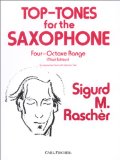
However, I was looking through Top Tones for the Saxophone last night and reading what Rascher said.
It is useful to extend the range of the saxophone.
But the main benefit is that if you can do altissimo, your sound will be better overall on the saxophone.
You’re working on control, overtones, a lot of elements that relate directly to your sound.
It will make every note sound better if you spend the time and develop your altissimo playing.
So I think I’ll spend some more time on it!
To play in the altissimo, you need to understand the physics of your instrument.”
– Lenny Pickett pg 16 (Saxophone Masterclasses)
Altissimo refers to notes above high F# (the one above the staff). Which is the highest note on most fingering charts.
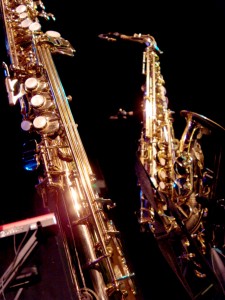
Altissimo requires special embouchure, listening, and control.
Players like Lenny Pickett throw in a lot of altissimo range and most professional (non-classical) sax players will hold out that screaming high note at least occasionally.
Lenny Pickett has also written about it in several articles in a couple of other books.
It’s a matter of developing your throat and being able to ‘hear’ the note in your head that you want to play.
Working on playing harmonics will help. ie, fingering a low Bb and without changing your fingering, use your throat to play the Bb above that and then a G and and then the Bb two octaves above, then D, etc.
However,
“It takes time to acquire, but you don’t want to sacrifice the rest of your instrument for the sake of the altissimo.”
-Lenny Pickett pg 17 (Saxophone Masterclasses)
So go ahead and develop it for part of your practice if you’re ready, but don’t focus too much on it if you’re going to neglect other elements of your practice.

It requires special embouchure, listening, and control.
Players like Lenny Pickett throw in a lot of altissimo range and most professional sax players will hold out that screaming high note at least occasionally.
Helen From Bassic Sax Blog:
Another good book that compliments this Rascher classic, is Beginning Studies in the Altissimo Register by Rosemary Lang.
What I like about Lang’s book is that each set of 2 pages is dedicated to a particular note. This way a student can actually gauge their progression through the altissimo range better.
I personally like using the Lang book to work on specific notes that might be giving me problems. For example, if I want to work on my B3 or D#4, I use the exercises specifically dedicated to those notes.
Discussing saxophone altissimo on the facebook page:
Richard: I have to play a high G on alto for a piece I am working on. If I’m using a Vito with a Meyer mouthpiece, what is the best fingering and do you have any tips that will help?
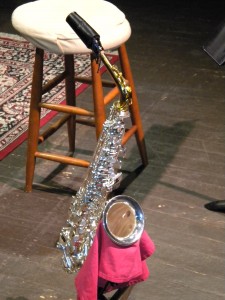
Neal: Can you play the harmonic series using the low Bb, B, and C fingerings? If so, how high can you go?
Courtney: Altissimo = a PAIN. I’ve had that same situation, a LOT of practice with those harmonics and your mouth shape.
Richard: I’m not sure how high I can go on B and C, but I can go to high Bb and almost the high F(I’ve done it two or three times, but can’t do it consistently).
Courtney: (I never did get to master it, it was too close to performance) but I just sat there and tried jumping between each harmonic, and then would start skipping every other one until I could play whichever one I wanted without having to start at the bottom. That high F and F sharp are a challenge to get consistently o.O
Richard: Is there a specific exercise you used that helped?
Courtney: I played around a lot with my mouth shape/tongue placement, yada. Took note of what worked best on my sax, I wasn’t really equipped though so whatever I did didn’t help all that much. Not sure exactly what to tell ya =/ you should talk to someone more experienced than I. xD
Richard: Thanks anyways. I was looking for like a worksheet or something with exercises in harmonics. I’ll ask my teacher when I see her next for something, but I was hoping somebody could suggest something in the mean time.
Neal: For now, just work on getting up to the second octave above the low note starting on Bb, B, and C. Make it clean and spend a little time on it everyday. The intervals are the same starting from those notes, I wrote it out for Bb here.
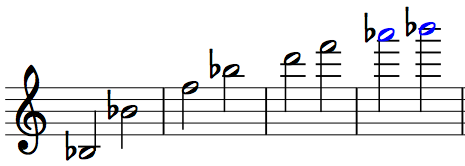
This is not the most musical of things to practice…. but a little every day not late at night shouldn’t make anyone too mad. And you’ll improve it gradually.
A set of exercises can be found in the book Top-Tones.
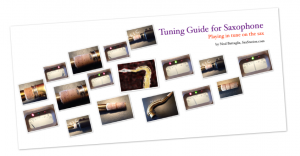 You want your saxophone to play in tune and blend with others. But you may notice that you’re sometimes out of tune, possibly only on certain notes and would like to fix that.
The problem
Playing out of tune immediately sticks out in a bad way. Even people who are not musicians often can tell if a singer or musician is quite a bit out of tune.
Because of the way the saxophone is built, tuning one note (even perfectly) does not ensure that all other notes will play in tune.
Low C could be flat, middle C could be in tune, high C could be sharp without adjusting anything on the saxophone.
Different Saxophones
More modern saxophones from reputable brands tend to play much more in tune than vintage saxophones. But it’s still good to know exactly how to get the saxophone in tune across the entire range of notes even if your horn tends to play pretty well in tune.
Every different horn you play is likely to be a bit different.
If you do play a vintage horn, there are tendencies that you need to be aware of to play in tune. Sometimes there are common tendencies. I have learned more about those as I have shifted to playing a vintage horn.
Many Factors!
The position of the mouthpiece on the neck cork is a big factor in intonation since it effectively changes the length of the saxophone, but the mouthpiece itself and reed also affect intonation.
How you move your fingers can affect intonation.
What is this guide?
The main part of this guide is a written guide to tuning. Structured in ten sections.
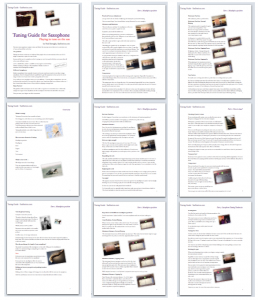
Part of the guide
Part 1: mouthpiece position
Part 2: how to tune?
Part 3: saxophone tuning tendencies
Part 4: repairs?
Part 5: mouthpiece & reed
Part 6: fingers & tuning
Part 7: comfort level & tuning
Part 8: tone & intonation
Part 9: Examples
Part 10: Recommendations with checklist
Videos:
There is an introductory video about mouthpiece position & the possibilities of how much you can lip up and lip down notes.
A second video takes examples from three people of playing different notes and my recommendations for them to get better tuning.
Special offer the guide on tuning your saxophone
[feature_box style=”4″ only_advanced=”There%20are%20no%20title%20options%20for%20the%20choosen%20style” alignment=”center”]
“That’s not gong fu.
We stared at each other for a long time, then he raised one eyebrow. I could fix it, if you wanted. I must have nodded, because then he asked me if I could chi ku, eat bitter, the Chinese expression to endure suffering.”
[/feature_box]
(pg. 68 Iron and Silk
Playing things on saxophone that are comfortable can be fun.
In fact, you want to get everything you play to be comfortable. That’s when you will sound the best.
When you perform on stage, you want to be comfortable! Otherwise…. you’re probably going to be frustrated and not sound great (or as good as you would like).
Imagine two areas: comfort and panic on a spectrum. It turns out, some discomfort is crucial to improving. But when you experience that discomfort should be in a particular environment.
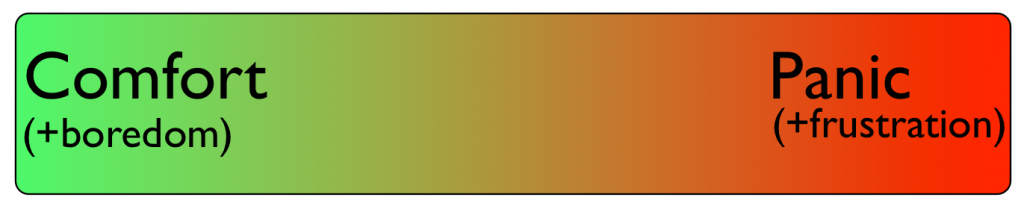
Struggling to play tends to sound bad and feel frustrating. Not be able to play as you wish.
Frustrating because you do not have the control you want.
Not being in control and not even knowing where to go from your current situation can be extremely frustrating. Unfortunately, that is the situation for many musicians. I have been there in the past. It turns out you need to experience some discomfort in order to escape the plateau, the ‘sounding okay, but not good’.
Our minds have mechanisms in which things become habit. And to change habits and sound better, you need to step away from what is comfortable.
Unfortunately, you do not improve when things are comfortable.When things are comfortable that really means you are not thinking about them, they happen automatically by habit. And if you don’t think about something, it tends to stay the same.
There are things you do in your life in which you improved rapidly at first. Take driving as an example. But then you get ‘good enough’ and you do it automatically. You’re not really getting better at driving most of the time after you initially learn it. You just do it and unless there are major problems, your skill level stays about the same.
Taking lessons with an effective saxophone teacher can be uncomfortable. There is the expectation that you practice your instrument before you arrive. Then the teacher will likely be able to hear things in your playing immediately that you don’t always notice.
All the problems get noticed. Then you can work on things.
The teacher likely knows what things are important to spend time on. How to effectively practice.
It may not be ‘fun’ but the results you get are definitely fun. The part where you start sounding better and continue to improve.
It’s all right for things to be uncomfortable in lessons and when you practice. Between comfort and panic you learn and improve.
What you can play expands and music becomes more interesting.
You need challenges in order to progress. That means moving away from comfort and towards panic a little bit.
It takes more effort and control. With music, it means really listening and figuring out what to work on.
You don’t want to completely switch gears and go all the way into complete panic though! That is also a problem.

How much you push yourself depends on your willpower and ability to handle challenges.
It’s easy to develop habits which can be good or bad.
Fingers that move inefficiently. A strange position with your embouchure. Not knowing about different ways to articulate. Being only comfortable in a few keys.
Without a sense of direction, which a teacher can provide, it’s much easier to develop bad habits.
In the first weeks and months of playing saxophone, it can be somewhat clear what you need to do if you know some of the basics already and are on the path to developing good habits.
If you don’t know how to play any notes, you learn your first notes. Having a teacher and/or taking a beginning saxophone class is important to establish good habits from the start. And working through a solid book can also be helpful.
You learn about the basic rhythms. Then you play some songs with what you know. You start to learn about dynamics and the language of music.
At some point though, you exhaust the low hanging fruit. Learning a new note is a substantial improvement if you only know three notes. Beyond a certain point it becomes much harder to add notes and may not even be the most important thing to work on.
After a little while it can be unclear what your priorities should be. What you should practice. How you should practice.
If music is something you care about then you probably want to sound better.
Sounding better requires stepping away from what is comfortable and putting in some work.
To expand your awareness means focusing on listening and being aware of your sound.
Listening to records of great music and reading about ideas can help.
The feedback on your playing from an effective teacher can be critical to improving your sound. Someone who has learned the saxophone and can hear the things you cannot.
After you have done those things, go to this page and ask a question to get some help.
Great jazz standard, sang by Frank Sinatra and played by many more. A few of my students in Saxophone Tribe have worked on this tune.
Note:
The ‘solutions’ to the music (the notes for this lesson) are listed below the video. They’re not listed all at once though. They’re listed one at a time. You can scroll down to see one and then if you want to check the next one, you’ll need to scroll down farther. In this way, it’s a slight bit of a hassle to check the next note and I would encourage you to not look unless completely necessary.
Use the fingering chart if you need to.
Try it out! And let me know how it goes and what you think of the format.
Share it on Facebook and Google + if you like it!
Thanks
First Note
Tenor Saxophone & Soprano Saxophone:
Alto Saxophone & Baritone Saxophone:
.
.
.
.
.
Second Note
Tenor Saxophone & Soprano Saxophone:
Alto Saxophone & Baritone Saxophone:
.
.
.
.
.
Third Note
Tenor Saxophone & Soprano Saxophone:
Alto Saxophone & Baritone Saxophone:
.
.
.
.
.
Fourth Note
Tenor Saxophone & Soprano Saxophone:
Alto Saxophone & Baritone Saxophone:
.
.
.
.
.
Fifth Note
Tenor Saxophone & Soprano Saxophone:
Alto Saxophone & Baritone Saxophone:
.
.
.
.
.
Sixth Note
Tenor Saxophone & Soprano Saxophone:
Alto Saxophone & Baritone Saxophone:
.
.
.
.
.
Seventh Note
Tenor Saxophone & Soprano Saxophone:
Alto Saxophone & Baritone Saxophone:
.
.
.
.
.
Eighth Note
Tenor Saxophone & Soprano Saxophone:
Alto Saxophone & Baritone Saxophone:
.
.
.
.
.
Ninth Note
Tenor Saxophone & Soprano Saxophone:
Alto Saxophone & Baritone Saxophone:
.
.
.
.
.
Tenth Note
Tenor Saxophone & Soprano Saxophone:
Alto Saxophone & Baritone Saxophone:
.
.
.
.
.
Eleventh Note
Tenor Saxophone & Soprano Saxophone:
Alto Saxophone & Baritone Saxophone:
.
.
.
.
.
Twelfth Note
Tenor Saxophone & Soprano Saxophone:
Alto Saxophone & Baritone Saxophone:
.
.
.
.
.
Thirteenth Note
Tenor Saxophone & Soprano Saxophone:
Alto Saxophone & Baritone Saxophone:
.
.
.
.
.
Fourteenth Note
Tenor Saxophone & Soprano Saxophone:
Alto Saxophone & Baritone Saxophone:
.
.
.
.
.
Fifteenth Note
Tenor Saxophone & Soprano Saxophone:
Alto Saxophone & Baritone Saxophone:
.
.
.
.
.
Sixteenth Note
Tenor Saxophone & Soprano Saxophone:
Alto Saxophone & Baritone Saxophone:
.
.
.
.
.
Seventeenth Note
Tenor Saxophone & Soprano Saxophone:
Alto Saxophone & Baritone Saxophone:
.
.
.
.
.
Eighteenth Note
Tenor Saxophone & Soprano Saxophone:
Alto Saxophone & Baritone Saxophone:
.
.
.
.
.
Ninteenth Note
Tenor Saxophone & Soprano Saxophone:
Alto Saxophone & Baritone Saxophone:
.
.
.
.
.
Twentieth Note
Tenor Saxophone & Soprano Saxophone:
Alto Saxophone & Baritone Saxophone:
.
.
.
.
.
Twenty First Note
Tenor Saxophone & Soprano Saxophone:
Alto Saxophone & Baritone Saxophone:
.
.
.
.
.
Twenty Second Note
Tenor Saxophone & Soprano Saxophone:
Alto Saxophone & Baritone Saxophone:
.
.
.
.
.
Twenty Third Note
Tenor Saxophone & Soprano Saxophone:
Alto Saxophone & Baritone Saxophone:
Check out Saxophone Tribe for more lessons like this!
To sign up for the (challenging) saxophone ear training class, go to this page
The World Saxophone Quartet playing Hattie Wall in Lovejoy, Illinois.
The World Saxophone Quartet is made up of Bluiett and Oliver Lake, James Carter and Greg Osby. Bluiett went to this school and returned to play the concert.

Want to play saxophone, but feeling lost and not sure how to get started?
In this online/downloadable class you will see methodical lessons in a sequence and you can get feedback and ask questions at any point.
Learn more
Want to take your playing to the next level?
You’ll learn fundamental saxophone skills, building past the basics. Master rhythms. Learn about phrasing, tone, and more. Here you will get feedback which is crucial to developing good habits.
Learn more